

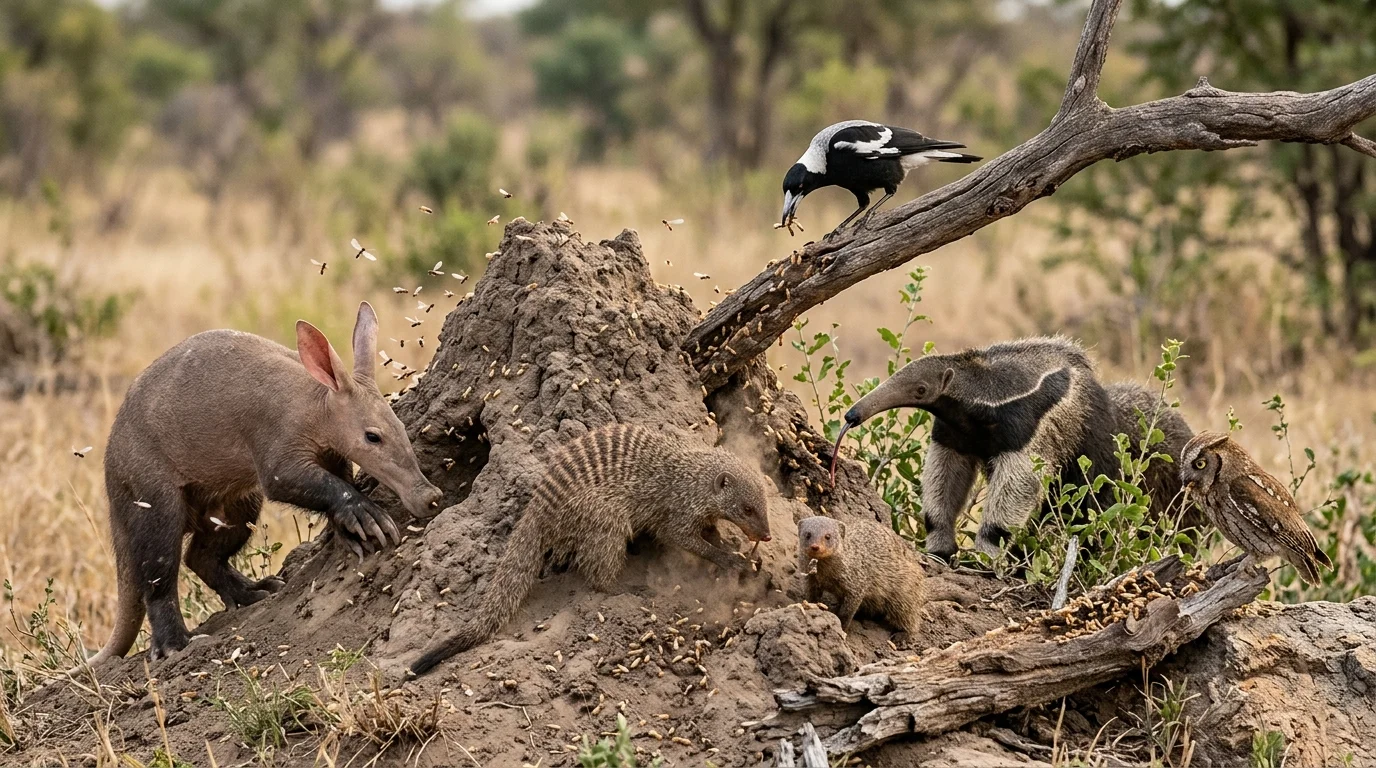
Termites inflict between 5 billion and 7 billion dollars in structural damage across the United States every year; left unchecked, a single colony can quietly hollow out your home’s wooden framing. While chemical barriers offer immediate property protection, nature provides a surprisingly formidable lineup of specialized hunters capable of suppressing insect populations naturally. Understanding which animals eat termites reveals how balanced ecosystems manage these destructive pests and gives you fresh insights into eco-friendly pest control strategies. From nocturnal burrowers to aggressive subterranean insects, these five remarkable predators actively target termite colonies, devouring tens of thousands of workers daily while safeguarding forests and surrounding landscapes from uncontrolled infestation.

Fast Facts
Property Damage Scale: Homeowners across the United States spend between $5 billion and $7 billion every year on termite extermination and structural repairs, while global costs top $40 billion annually.
Massive Worker Numbers: An average mature subterranean termite colony contains between 60,000 and 300,000 active workers that can consume up to 22 linear feet of standard pine lumber within a single year.
Aardvark Appetite: The African aardvark uses its powerful digging claws and twelve-inch sticky tongue to consume up to 50,000 termites and ants during a single night of foraging.
Anteater Efficiency: A giant anteater rips open rock-hard termite mounds with four-inch talons, using a two-foot-long tongue to eat up to 30,000 insects daily without ever destroying a mound completely.
Subterranean Nemesis: Predatory ants represent the primary biological enemy of termites worldwide, aggressively raiding underground galleries to conquer colonies and steal larvae for food.
Aerial Interceptors: Birds such as woodpeckers, sparrows, and guinea fowl gorge on winged termite swarmers during spring mating flights, intercepting thousands of reproductive adults before they establish new nests.
Reptilian Patrols: Amphibians and reptiles—including tree frogs, toads, and geckos—wait near damp wooden structures to target nocturnal termite swarms during humid spring evenings.
Advanced Baiting Systems: Eco-friendly chitin synthesis inhibitor baiting systems eliminate subterranean termite colonies within 30 to 90 days by disrupting their molting process without requiring harsh liquid chemical barriers.
Ecological Engineers: Despite their destructive potential in residential homes, termites perform vital environmental work in natural forests by breaking down dead wood and turning hard soil into fertile ground.
Microscopic Predators: Entomopathogenic nematodes act as microscopic natural predators, invading termite bodies in damp soil environments and releasing lethal bacteria that neutralize underground workers quickly.

Context and Background
To understand why animals that eat termites play such a critical role in global ecosystems, you must first appreciate the scale of a termite infestation. Termites exist as social insects divided into distinct castes: reproductive swarmers, defensive soldiers, and soft-bodied workers. A single subterranean colony usually harbors between 60,000 and over 300,000 active workers. These subterranean workers labor continuously without sleep, chewing through cellulose found in dead trees, fallen branches, and structural lumber. A mature colony of 300,000 workers can easily devour 22 linear feet of standard two-by-four framing wood in a single year, causing structural failure before a property owner notices any outward signs of activity.
Financial losses from these insects add up rapidly. U.S. property owners spend between $5 billion and $7 billion each year fixing structural timber and applying control measures. Worldwide, economic impacts top $40 billion annually. While conventional chemical treatments create toxic soil barriers around foundations, relying exclusively on synthetic pesticides often overlooks nature’s natural control mechanisms. Balanced environments rely heavily on specialized termite predators to check population growth, prevent unchecked swarms, and protect healthy forests.
1. Ants: The Undisputed Biological Rival
Ants stand out as the single most effective natural enemy of termites on Earth. Because ants and termites share similar subterranean nesting habitats and search for similar resources, competition between these two insect groups remains relentless. Aggressive ant species—such as Argentine ants, carpenter ants, and driver ants—frequently locate subterranean termite tunnels and launch full-scale military raids. When worker ants breach a mud tube, soldier termites rush to form a physical defense line with their enlarged, armored heads and snapping mandibles; however, ants usually overpower them through superior mobility, coordinated chemical signaling, and sheer numbers.
Ants do not merely kill termites out of aggression; they harvest them as a rich source of protein and fats to feed their own queens and developing larvae. In tropical ecosystems, driver ants clear out massive subterranean termite colonies in a matter of hours. Even in residential yards, a healthy outdoor ant population works as a continuous defense layer, suppressing termite workers before they establish large colonies near your home’s foundation. Maintaining natural lawn biodiversity helps sustain these beneficial ant species as part of an integrated natural termite control approach.
2. Aardvarks: Subterranean Excavation Specialists
In the savannas and woodlands of sub-Saharan Africa, the aardvark (Orycteropus afer) serves as a specialized mammalian predator engineered specifically to hunt termites and ants. Weighing up to 140 pounds, this nocturnal mammal possesses incredibly powerful front legs equipped with thick, shovel-like claws. An aardvark easily tears open concrete-hard termite mounds that easily resist human picks and shovels. Once it breaches the outer wall, the aardvark extends its specialized 12-inch sticky tongue into the colony’s interior chambers, sweeping up thousands of defending insects in seconds.
A single adult aardvark consumes up to 50,000 termites and ants in a single evening of foraging. Because aardvarks possess tough, leathery hide and nostrils that seal shut during digging, defensive soldier termites cannot sting or bite the animal effectively. Interestingly, aardvarks rarely destroy an entire colony during a single feed. They leave the core nest intact, allowing the surviving termite workers to repair the structure, which creates a sustainable, renewable food supply for the aardvark’s next foraging visit across its territory.
3. Giant Anteaters: Specialized High-Volume Feeders
Across Central and South America, the giant anteater (Myrmecophaga tridactyla) fills a similar ecological niche to the African aardvark. Growing up to seven feet long from snout to tail, this distinct mammal relies almost exclusively on termites and ants for its daily calories. Lacking teeth entirely, the giant anteater depends on a two-foot-long, muscular tongue coated in sticky, viscous saliva produced by oversized salivary glands. This long tongue flickers in and out of termite galleries up to 150 times per minute, scooping up insects with astounding speed.
A giant anteater devours roughly 30,000 termites and ants every day to meet its energetic needs. Using four-inch front claws, the giant anteater rips open hard mound walls, feeds rapidly for one to two minutes, and then moves on before the termite colony mobilizes its chemical and physical defenses. This quick feeding strategy minimizes painful bites from termite soldiers while preventing the total collapse of the insect colony. Consequently, giant anteaters maintain a balanced ecosystem, ensuring termite populations remain managed without driving their primary food source to localized extinction.
4. Avian Interceptors: Aerial Guardians During Swarming Season
While mammalian predators target ground mounds, birds dominate the skies when mature termite colonies produce winged reproductive adults, known as alates or swarmers. During warm, humid spring days following heavy rainfall, thousands of winged termites exit subterranean nests simultaneously to embark on brief nuptial flights. These massive swarms create a temporary feast for localized bird populations, attracting species like woodpeckers, sparrows, toucans, swallows, and domestic or wild guinea fowl.
Woodpeckers use their specialized, chisel-shaped beaks to chip away decaying wood and bark to extract worker termites hiding beneath the surface year-round. Meanwhile, aerial hunters like swallows and flycatchers swoop through swarming clouds, snapping up thousands of reproductive termites mid-air before the insects land, shed their wings, and mate. Ground-dwelling fowl, such as chickens and guinea fowl, scratch through leaf litter to consume swarming adults on the ground. Encouraging native bird populations in your yard offers an effective aerial line of defense during peak swarming periods.
5. Reptiles and Amphibians: Nighttime Ground Patrols
Reptiles and amphibians represent another critical group of animals that eat termites. Geckos, skinks, legless lizards, tree frogs, and American toads patrol humid, shaded environments around home perimeters, woodpiles, and forest floors where termites frequent. Because subterranean termites require high moisture levels to prevent their soft bodies from drying out, they frequently cross paths with moisture-seeking amphibians and ground-dwelling lizards.
A single adult toad sitting near an exterior light source can consume hundreds of emerging swarming termites in a single night. Geckos and skinks stalk damp crawl spaces, beneath wooden decks, and inside leaf litter, snapping up foraging termite workers as they travel along mud tubes or moist soil lines. By keeping outdoor lighting subtle and maintaining natural garden habitats, you encourage these beneficial reptiles and amphibians to reside on your property, establishing continuous nocturnal pest control.

Interesting Connections
The relationship between termites and their predators extends far beyond simple survival; it has shaped evolutionary history, landscape geography, and modern agricultural practices. The endless war between ants and termites has driven incredible evolutionary adaptations over tens of millions of years. Subterranean termites developed specialized soldier castes equipped with oversized mandibles capable of slicing enemy insects in half, while other species possess head nozzle-like structures (nasutes) that spray sticky, toxic chemical compounds to immobilize attacking ants. In response, predatory ants developed thick exoskeletons and coordinated tactical raiding behavior to bypass these chemical defenses, illustrating a biological arms race that continues in your backyard soil today.
Mammalian termite predators also function as critical habitat creators for other wildlife species. When an African aardvark excavates a deep, hard-packed termite mound to reach its prey, it leaves behind massive subterranean burrows. These abandoned burrows provide vital shelter, breeding sites, and refuge from wildfires for dozens of secondary species, including warthogs, hyenas, jackals, owls, and python snakes. Without aardvarks suppressing termite populations and digging these shelters, many African savanna species would lack crucial protection from harsh weather and apex predators.
For homeowners interested in eco-friendly pest control, understanding these natural systems helps guide practical home maintenance choices. Rather than relying entirely on synthetic chemical sprays that eliminate all soil insects—including beneficial predator ants—modern pest control emphasizes targeted management. Implementing effective termite prevention tips alongside biological controls creates a multi-layered defense strategy. For instance, advanced chitin synthesis inhibitor (CSI) baiting systems target subterranean colonies specifically. When termites feed on CSI baits and share them with the colony, the active compound disrupts chitin production, preventing workers from molting successfully.
CSI baiting systems typically eliminate entire subterranean colonies within 30 to 90 days while leaving non-target predators like ants, birds, and lizards completely unharmed. Furthermore, introducing entomopathogenic nematodes into damp perimeter soil offers a natural biological barrier. These beneficial microscopic worms enter termite workers and release lethal bacteria, eradicating subterranean nests naturally. Combining these intelligent methods with natural predator habitats allows you to protect your home’s structural integrity while maintaining a thriving, balanced landscape ecosystem.
Frequently Asked Questions
Can natural predators completely eliminate an active termite infestation inside a house?
No, natural predators alone cannot eradicate an established termite infestation inside a home’s structural framing. While birds, ants, and lizards consume thousands of termites outdoors, they cannot safely reach workers feeding hidden inside dry walls, floor joists, or foundation sills. If you suspect active structural damage, you should immediately combine professional eco-friendly pest control methods—such as chitin synthesis inhibitor bait stations or specialized localized treatments—with preventive maintenance to protect your investment.
Does having ants in my yard mean my home is safe from termites?
Having ants in your yard significantly reduces the likelihood of subterranean termite colonies expanding unchecked, as ants naturally raid termite tubes and compete for ground territory. However, an outdoor ant population does not guarantee total immunity. Termites often build subterranean shelter tubes deep beneath soil or enter homes through tiny foundation cracks where ants cannot easily follow. Maintaining active yard inspection alongside natural ant populations provides the best security.
How do beneficial nematodes act as natural termite predators?
Entomopathogenic nematodes are microscopic, soil-dwelling roundworms that act as natural parasites targeting soft-bodied insects. When applied to damp soil around your foundation, these nematodes search out subterranean termite workers, enter through natural body openings, and release symbiotic bacteria. This bacteria neutralizes the termite within 24 to 48 hours, allowing the nematodes to reproduce and spread throughout the subterranean colony without using toxic chemicals.
What simple yard modifications encourage natural termite predators?
You can encourage natural termite predators by creating welcoming outdoor habitats. Install bird feeders, birdbaths, and nesting boxes to attract insect-eating birds like sparrows and swallows. Leave undisturbed rock piles, mulch beds, or garden features to provide shelter for beneficial geckos, toads, and ground-dwelling predatory ants. Additionally, minimize unnecessary broad-spectrum pesticide use, as these chemicals kill beneficial predators alongside unwanted pests.
What practical termite prevention tips protect home framing naturally?
Effective termite prevention tips focus on moisture control and physical barrier maintenance. Fix leaking outdoor spigots, clear clogged rain gutters, and ensure soil slopes away from your foundation to prevent water accumulation. Keep firewood, stacked lumber, and cardboard stored at least 20 feet away from your home’s exterior walls, and maintain a two-inch gap between soil and wooden siding or deck supports to block subterranean termite mud tubes.
