

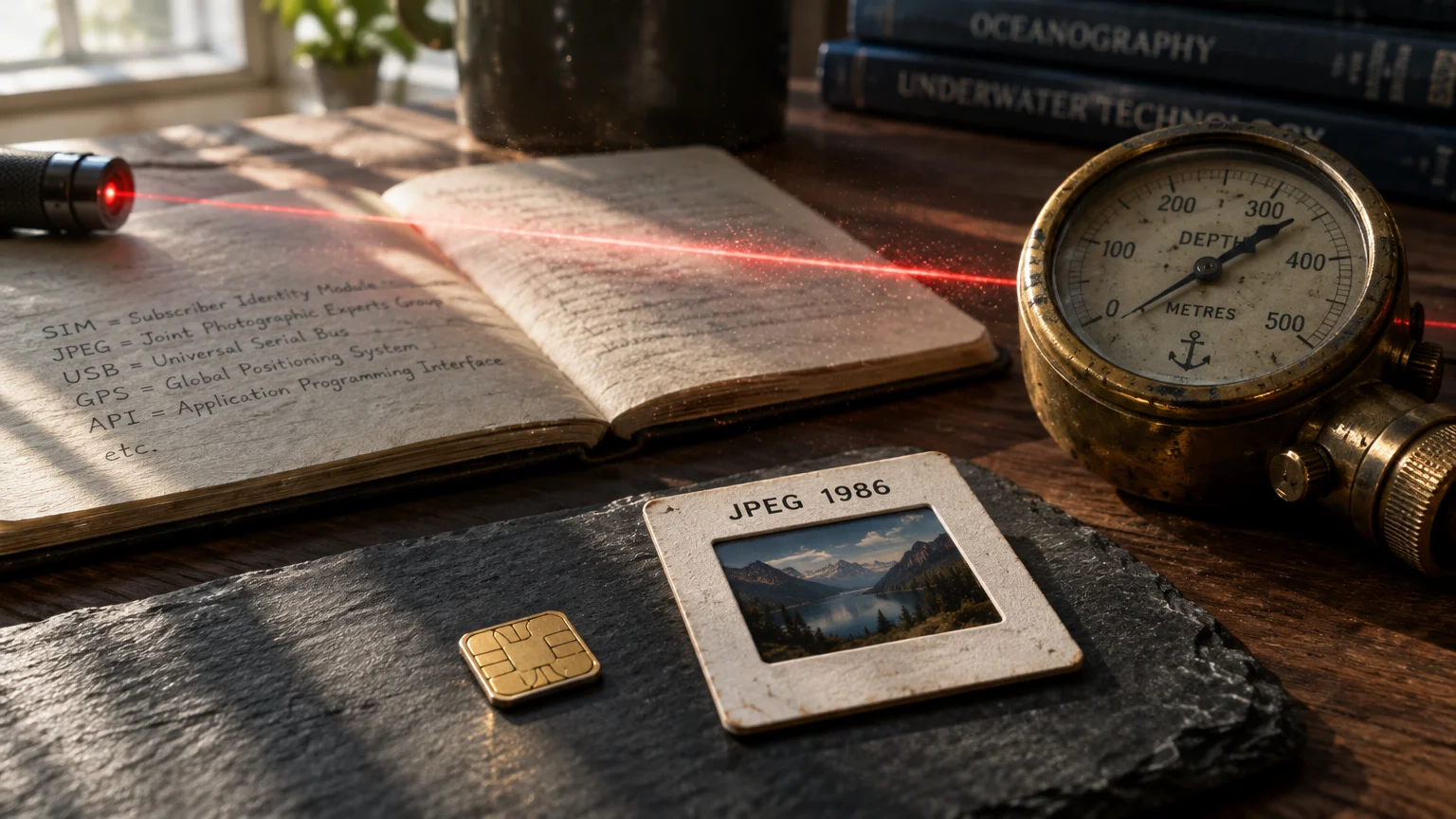
You encounter shortened terms on your phone, at work, and in daily conversation without knowing their full forms. Decoding these everyday abbreviations sharpens your communication and helps you understand the tools you rely on daily.
Many people confuse acronyms with initialisms or assume that common words like laser and scuba were always standard vocabulary. Learning their original definitions transforms obscure letter combinations into practical knowledge.
This guide unpacks the true acronym meanings behind fifteen terms you see constantly, giving you instant clarity and useful historical insights.
Fast Facts
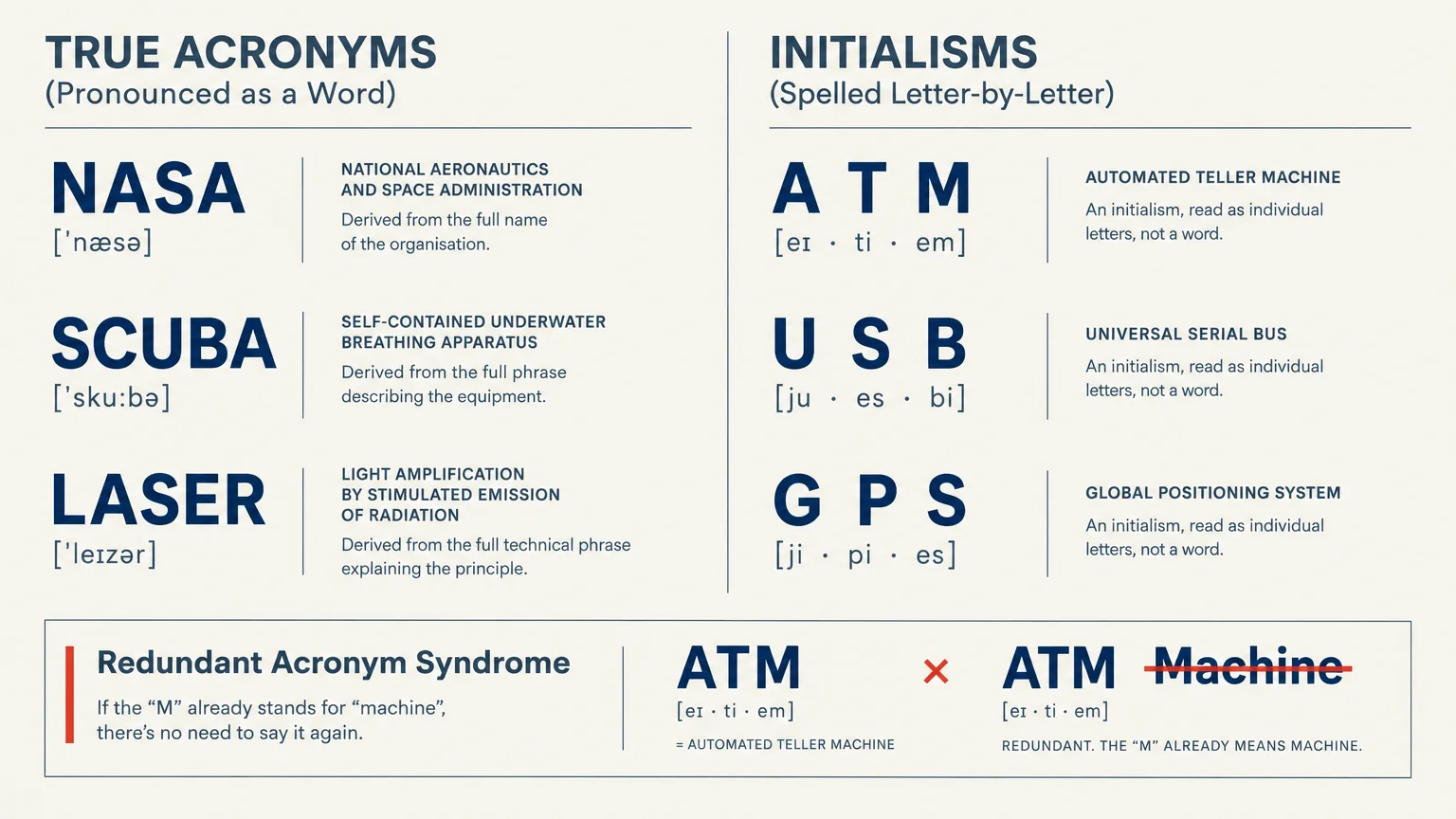
Acronyms differ from initialisms. You pronounce true acronyms as single words like NASA, whereas you spell out initialisms letter by letter like ATM or USB.
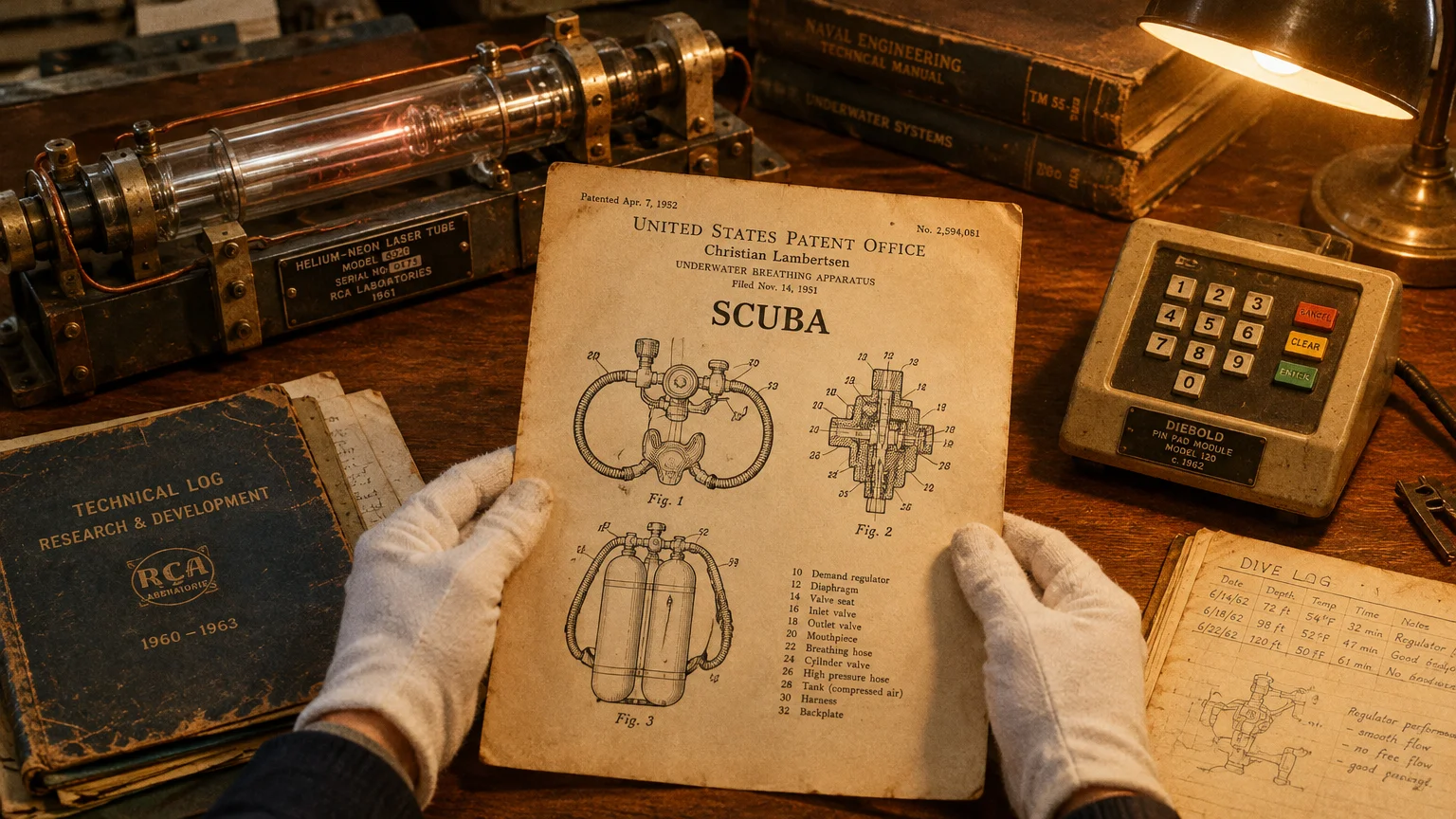
SCUBA started as naval gear. The term stands for Self-Contained Underwater Breathing Apparatus, patented by Christian Lambertsen in 1952 for military swimmers.
LASER describes a physical reaction. It represents Light Amplification by Stimulated Emission of Radiation, which physicist Gordon Gould named in 1957.
CAPTCHA honors Alan Turing. This internet security test stands for Completely Automated Public Turing test to tell Computers and Humans Apart.
Saying “ATM machine” creates redundancy. Because the letter M represents machine, adding the word machine duplicates the concept through Redundant Acronym Syndrome.
SIM cards store your cellular identity. SIM stands for Subscriber Identity Module, which encrypts network authorization keys directly on your mobile device.
Clock designations stem from Latin. AM represents ante meridiem, meaning before midday, while PM stands for post meridiem, meaning after midday.
Radar originated as wartime shorthand. It abbreviates Radio Detection and Ranging, a surveillance technology named by the United States Navy in 1940.
RSVP demands a reply. The acronym abbreviates the formal French expression répondez s’il vous plaît, which translates to please reply.
JPEG represents a committee. The digital photography format stands for Joint Photographic Experts Group, established in 1986 to compress image files.
PIN protects your transactions. PIN stands for Personal Identification Number, invented by James Goodfellow in 1965 to automate banking verification.
GPS relies on atomic clocks. Global Positioning System uses twenty-four satellites to calculate your ground position within meters.
Context and Background
Every language relies on shorthand to compress complex ideas into fast exchanges. Exploring everyday abbreviations allows you to parse technical documents and daily workplace communications with greater precision.
Linguists classify shortened words into distinct structural categories. You pronounce acronyms as complete words, initialisms as separate letters, and standard abbreviations as compressed spellings of longer phrases.
Understanding each common acronyms meaning helps you communicate with technical teams and avoid awkward misunderstandings. Recognizing common abbreviations prevents misinterpretation during critical projects.
Resources like Merriam-Webster document how technical shorthand often transitions into standard lowercase vocabulary over time. Reviewing the fifteen terms below will help you identify their origins and apply them accurately.
1. ASAP – As Soon As Possible
You see ASAP in workplace emails and text messages when someone requests immediate action. People pronounce it either as a single word or as individual letters.
The United States military popularized the term during the mid-twentieth century to communicate urgency without panic. When you assign tasks, pair ASAP with a concrete deadline to prevent mismatched expectations.
Using the phrase too frequently dilutes its urgency in team settings. Reserve it for critical project milestones to ensure colleagues respond promptly.
2. RSVP – Répondez S’il Vous Plaît
Event hosts place RSVP on formal invitations to request an attendance count. The letters represent the French phrase répondez s’il vous plaît, which translates to please reply.
Proper etiquette requires you to respond whether you accept or decline the invitation. Sending your answer promptly helps organizers finalize seating charts and catering budgets without unnecessary waste.
If an invitation states “RSVP regrets only,” you only need to contact the host if you cannot attend. Silence indicates that you will be present.
3. CAPTCHA – Completely Automated Public Turing Test to Tell Computers and Humans Apart
Web services present CAPTCHA prompts when you create accounts or submit forms. The test blocks automated bots from overwhelming online databases with spam.
The system honors computing pioneer Alan Turing, whose famous test measured machine intelligence. Modern versions evaluate your browsing behavior and mouse physics rather than forcing you to read warped text.
Advanced security systems now implement reCAPTCHA v3, which scores user risk invisibly without interrupting your browsing session.
4. SIM – Subscriber Identity Module
Your smartphone requires a SIM card to register with your cellular carrier network. The card holds a microchip storing your personal subscriber identity module.
This chip holds your account credentials, security keys, and international subscriber identity. Transferring an active card moves your mobile plan and phone number between unlocked smartphones within seconds.
Modern devices also support eSIM technology, which replaces removable plastic cards with a rewritable digital chip embedded directly on your phone motherboard.
5. PIN – Personal Identification Number
You enter a PIN to access bank accounts, unlock digital devices, and disarm home security systems. Engineer James Goodfellow created the system in 1965 to secure automated banking.
Because the N stands for number, avoid saying PIN number in conversation. Boost your personal security by creating unique codes that avoid calendar dates or obvious numerical sequences.
Security analysts recommend choosing six-digit combinations whenever applications permit them. Longer numeric codes exponentially increase resistance against brute-force guessing attacks.
6. ATM – Automated Teller Machine
An ATM lets you withdraw cash, transfer funds, and deposit checks at any hour. The technology replaced manual banking queues by routing transactions through encrypted financial networks.
British bank Barclays deployed the first operational unit in north London in 1967. Remember that saying ATM machine repeats the word machine unnecessarily.
Modern cash machines communicate over global interbank networks to process foreign currency conversions in real time. Inspect card slots for tampering before inserting your card to defend against skimmers.
7. GIF – Graphics Interchange Format
You send GIFs across messaging apps to share short animations and expressive reactions. Computer scientist Steve Wilhite led the CompuServe team that created the format in 1987.
The file type compresses multi-frame palettes efficiently to enable rapid playback on web pages. Wilhite clarified that the acronym uses a soft G sound, matching the peanut butter brand.
Modern developers frequently replace traditional animated GIF files with short MP4 video loops. Compressed video files load faster and consume significantly less cellular bandwidth.
8. JPEG – Joint Photographic Experts Group
Most digital cameras and smartphones save photos in the JPEG format. The acronym references the Joint Photographic Experts Group, the international committee that established the standard in 1992.
The algorithm uses lossy compression to reduce file sizes while maintaining perceived visual quality. Use JPEG for photographic imagery, but select PNG formats when you require crisp vector lines or transparency.
Repeatedly saving an existing JPEG degrades image clarity because the software recompresses pixel data on every export. Keep an uncompressed master file whenever you plan extensive photo editing.
9. USB – Universal Serial Bus
USB cables connect peripherals, storage drives, and chargers to your modern devices. Technology leaders developed the standard in 1996 to replace dozens of competing, proprietary connectors.
In computing terminology, a bus refers to an electrical pathway that transfers data between components. Reversible USB-C interfaces now deliver high-speed data transfer, video output, and rapid power delivery over a single cord.
Labels like USB 3.2 or USB4 specify transfer throughput rather than connector shape. Always check both shape and speed ratings when buying replacement cables.
10. GPS – Global Positioning System
Your smartphone navigation apps rely on GPS to calculate your geographic position. The United States Department of Defense launched the satellite constellation during the 1970s for military navigation.
At least twenty-four operational satellites orbit Earth, broadcasting atomic clock time signals continuously. Your device determines its location by measuring tiny arrival time differences between four or more satellites.
Civilian receivers achieve pinpoint accuracy by cross-referencing satellite data with local cellular towers. Dense tree canopies and tall urban high-rises can reflect signals and temporarily reduce location accuracy.
11. LASER – Light Amplification by Stimulated Emission of Radiation
Lasers power barcode scanners, high-speed fiber internet lines, and precision surgical instruments. Physicist Gordon Gould coined the acronym in 1957 to describe a new method of light amplification.
As documented by Encyclopaedia Britannica, lasers produce coherent beams where all light waves share the exact same wavelength and phase. Today, English dictionaries treat laser as an ordinary lowercase noun and verb.
Industrial lasers cut heavy steel plates with sub-millimeter accuracy using concentrated heat energy. Fiber-optic telecommunications rely on microscopic semiconductor lasers to transmit petabytes of data across oceans daily.
12. SCUBA – Self-Contained Underwater Breathing Apparatus
Ocean divers use SCUBA gear to breathe freely while exploring deep underwater environments. The acronym describes a self-contained underwater breathing apparatus that carries its own air supply.
Christian Lambertsen designed early rebreathing systems for military combat swimmers during World War II. Modern equipment uses demand regulators that supply air automatically at the diver ambient water pressure.
Recreational scuba tanks contain filtered atmospheric air rather than pure oxygen. Breathing pure oxygen at high underwater pressures triggers toxic central nervous system reactions.
13. RADAR – Radio Detection and Ranging
Air traffic controllers and weather forecasters use radar to monitor flights and storm systems. The United States Navy coined the term in 1940 from radio detection and ranging.
Radar antennas transmit pulses of electromagnetic waves that bounce off distant physical targets. Calculating the returning echo delay reveals the exact location, altitude, and velocity of any moving object.
Doppler radar systems analyze frequency shifts in returning waves to determine whether storms move toward or away from observation towers. Modern aircraft incorporate stealth geometry to scatter incoming radar waves away from receivers.
14. AM and PM – Ante Meridiem and Post Meridiem
Standard twelve-hour clocks divide each twenty-four-hour day into AM and PM intervals. These common abbreviations stem from the Latin terms ante meridiem and post meridiem.
The Latin word meridiem translates to midday or noon. Because noon marks the meridian itself, professional style guides suggest writing 12:00 noon or 12:00 midnight to avoid ambiguity.
Many international industries prefer twenty-four-hour military time to eradicate scheduling errors. Using a twenty-four-hour system prevents misinterpreting early morning departures as evening flights.
15. e.g. and i.e. – Exempli Gratia and Id Est
Writers frequently mix up the Latin abbreviations e.g. and i.e. in formal documents. Both provide clarifying information, but they perform distinct editorial duties in your prose.
Write e.g. when introducing a non-exhaustive list of examples, which translates to exempli gratia. Write i.e. when clarifying or restating your point directly, which translates to id est.
You can remember the distinction through English mnemonic associations. Match e.g. with “example given,” and connect i.e. with “in other words.”
Interesting Connections
Everyday abbreviations reflect how military engineering and commercial computing reshape spoken language. Acronyms that began as classified government projects frequently filter into commercial commerce and casual conversation.
With these practical acronyms explained, you can use technical shorthand with complete confidence. Understanding their structural roots helps you parse unfamiliar initialisms across emerging industries.
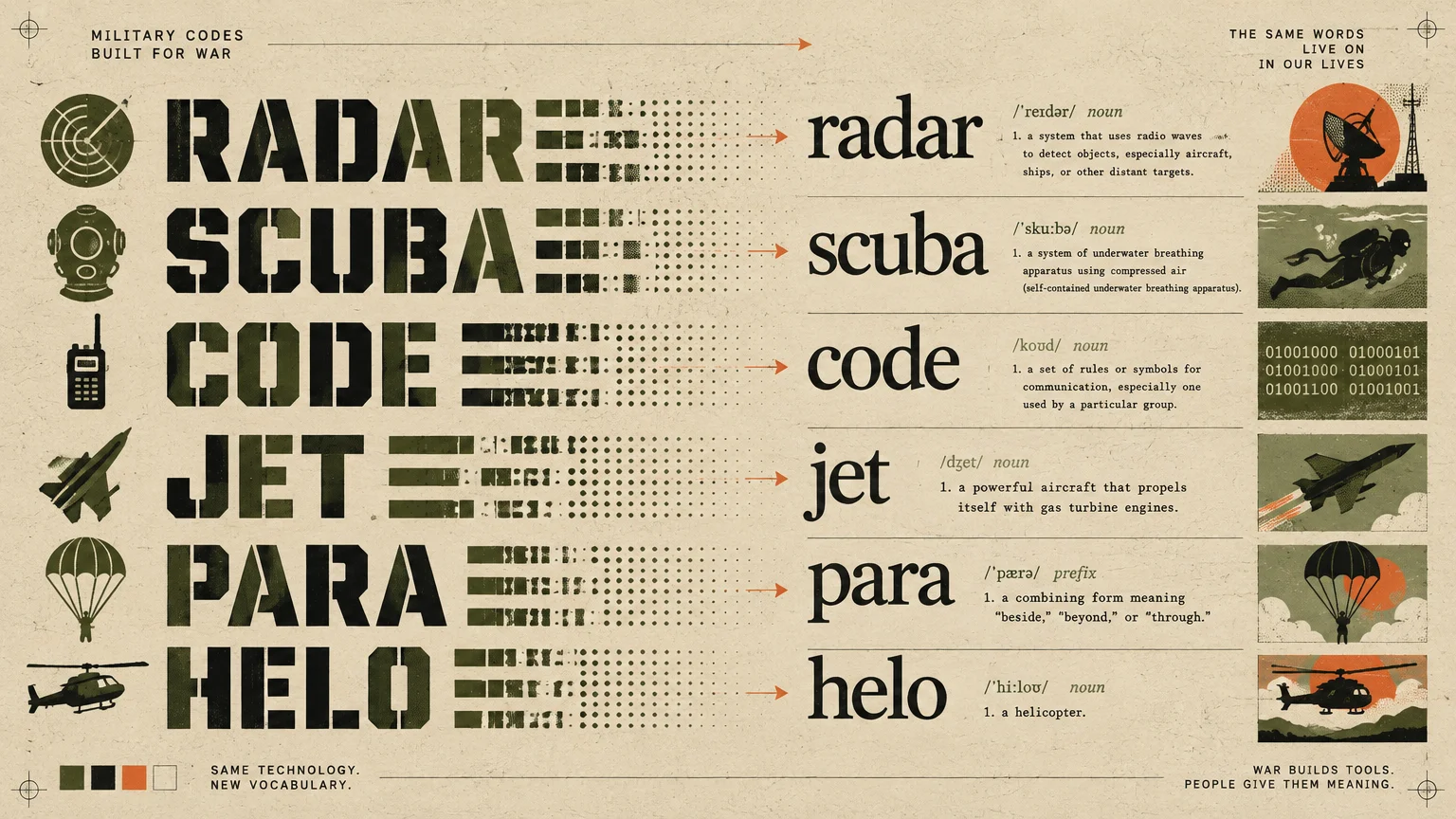
Linguistic adoption often follows a predictable cycle known as lexicalization. Highly successful acronyms like laser, radar, and scuba shed their capital letters and become conventional nouns in popular dictionaries.
You can observe this natural transition across modern technology agencies like NASA. While some initialisms remain capitalized forever, others blend seamlessly into functional vocabulary.
Psycholinguists also study Redundant Acronym Syndrome, commonly known as RAS syndrome. Speakers routinely attach repetitive words to abbreviations, producing phrases like PIN number, ATM machine, and LCD display.
Your brain produces these redundancies because it treats the acronym as an independent conceptual unit. Recognizing this pattern helps you edit your business writing for maximum brevity and impact.
Furthermore, global standards bodies like the World Wide Web Consortium standardize digital acronyms to ensure interoperability. Clear shorthand allows international developers to coordinate technical protocols without language barriers.
Frequently Asked Questions
What is the difference between an acronym and an initialism?
You pronounce an acronym as a single continuous word, such as NASA, SCUBA, or CAPTCHA. In contrast, you pronounce an initialism by speaking each individual letter aloud, such as ATM, USB, or FBI.
Both styles compress longer phrases into compact tags, but their spoken pronunciation dictates their linguistic classification.
Why do people say “PIN number” and “ATM machine”?
Speakers repeat these nouns because their minds process the abbreviation as a distinct, standalone entity. Linguists refer to this verbal habit as Redundant Acronym Syndrome.
While listeners understand your meaning, omitting the duplicate word produces tighter, more professional prose.
Is Wi-Fi an acronym for Wireless Fidelity?
Wi-Fi is not an acronym and does not stand for Wireless Fidelity. The founding branding firm created the catchy name as a commercial trademark to market IEEE 802.11b wireless standards.
The alliance briefly used the slogan The Standard for Wireless Fidelity in early marketing, which caused lasting public confusion.
How should you punctuate Latin abbreviations like e.g. and i.e.?
Standard American English style guides require periods after each letter in both e.g. and i.e. You should also place a comma directly after the second period in your sentence.
For instance, write your sentence with a leading clause, followed by e.g., and list your illustrative examples.
When does an acronym become a standard lowercase word?
An acronym drops its capital letters once speakers view it as an ordinary everyday object rather than technical shorthand. Editors and lexicographers verify this shift through widespread usage in literature and journalism.
Historical examples like scuba, radar, and laser demonstrate how deeply technical shorthand integrates into modern speech.
