


History often produces statistical anomalies so startling that you might mistake documented reality for theatrical fiction. When you examine recorded events across centuries, you uncover bizarre synchronistic moments that defy conventional intuition while remaining verified historical facts. From founding fathers dying on identical national anniversaries to uncanny literary predictions of maritime disasters, these strange true historical facts demonstrate how probability occasionally aligns in astonishing ways. Exploring these unbelievable historical coincidences helps you appreciate the mathematical inevitability of rare occurrences across billions of human lives, revealing how statistical chance shapes our collective heritage through episodes that genuinely sound invented.
Fast Facts
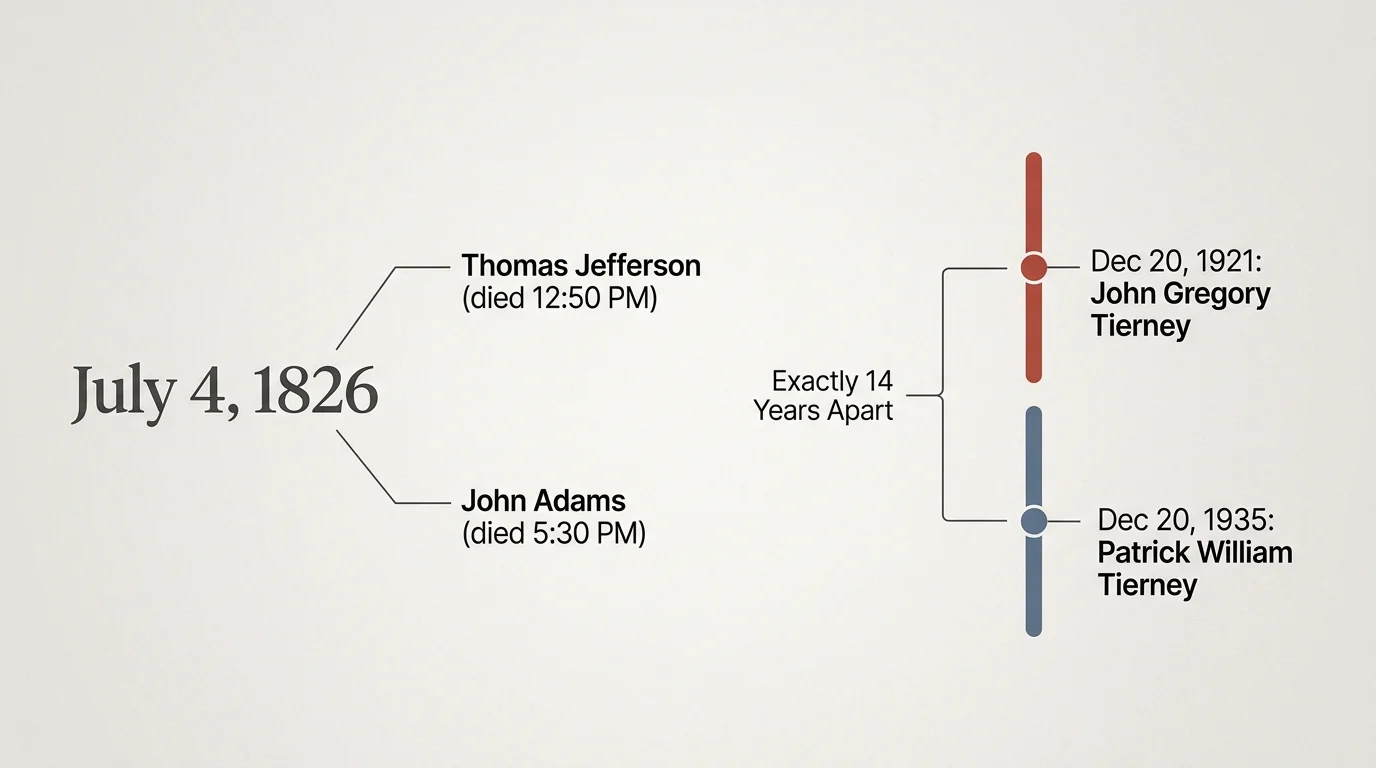
Thomas Jefferson and John Adams both died on July 4, 1826, exactly fifty years after the United States approved the Declaration of Independence. Adams passed away at age ninety in Massachusetts, unaware that the eighty-three-year-old Jefferson had died five hours earlier at Monticello.
Author Morgan Robertson published a novella titled Futility, or the Wreck of the Titan in 1898, describing an unsinkable British ocean liner named Titan that struck an iceberg in the North Atlantic during an April voyage. Fourteen years later, the RMS Titanic sank under nearly identical circumstances, matching Robertson’s fictional ship in size, speed, and severe lifeboat shortages.
American author Mark Twain arrived and departed this world in lockstep with Halley’s Comet. He was born on November 30, 1835, just two weeks after the comet reached perihelion, and died of heart failure on April 21, 1910, one day after the celestial body made its subsequent closest approach to the sun.
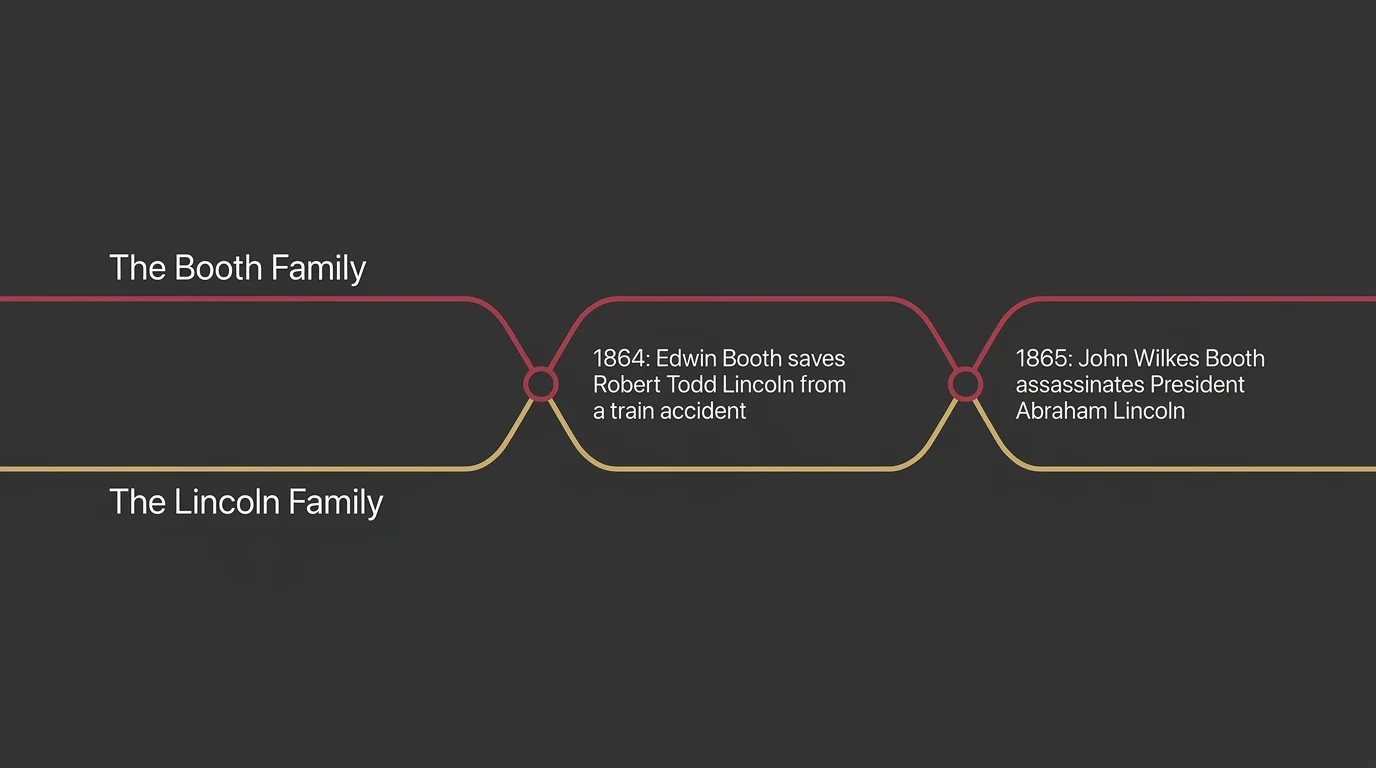
Edwin Booth saved Robert Todd Lincoln from severe injury or death on a New Jersey train platform mere months before Edwin’s brother, John Wilkes Booth, assassinated President Abraham Lincoln. Robert Lincoln later found himself in close proximity to the assassinations of Presidents James A. Garfield and William McKinley.
Wilmer McLean saw the American Civil War begin on his farm and conclude inside his living room. The First Battle of Bull Run erupted across his property in Manassas, Virginia, in 1861; four years later, General Robert E. Lee surrendered to General Ulysses S. Grant in the parlor of McLean’s replacement home in Appomattox Court House.
The first and last British soldiers killed in action during World War I rest permanently within seven yards of each other in Belgium. Private John Parr, who died in August 1914, and Private George Edwin Ellison, who fell ninety minutes before the armistice in November 1918, share opposing plots at Saint-Symphorien Military Cemetery.
The construction of the Hoover Dam claimed its first and final casualties exactly fourteen years apart to the calendar day. Government surveyor John Gregory Tierney drowned in the Colorado River on December 20, 1921, and his son, Patrick William Tierney, fell from an intake tower on December 20, 1935.
Ocean liner stewardess Violet Jessop survived catastrophic accidents aboard all three White Star Line Olympic-class sister vessels. She walked away unscathed from the RMS Olympic collision in 1911, escaped the sinking of the RMS Titanic in 1912, and survived the sinking of the HMHS Britannic in 1916.
Japanese naval engineer Tsutomu Yamaguchi survived both atomic bomb detonations in August 1945. He suffered severe burns less than two miles from ground zero in Hiroshima on August 6, returned home to Nagasaki, and survived the second nuclear blast on August 9 while describing his initial ordeal to his employer.
Context and Background
1. The Synchronized Deaths of Jefferson and Adams
The bitter political rivalry and eventual reconciliation of John Adams and Thomas Jefferson represent one of the most compelling narratives in early American history. Both men served on the Committee of Five appointed by the Second Continental Congress to draft the Declaration of Independence in 1776. Although their diverging political philosophies caused a bitter rift during the late 1790s, they rekindled their friendship through extensive correspondence during their twilight years, as documented by the National Archives.
By the summer of 1826, the United States prepared to celebrate the golden jubilee of its independence on July 4. Both former presidents suffered from failing health as the milestone approached. Jefferson slipped into a coma on the evening of July 3 and passed away at approximately 12:50 PM on July 4 at his Monticello estate. Hundreds of miles away in Quincy, Massachusetts, Adams suffered a fatal decline later that same afternoon. Before dying around 6:20 PM, Adams reportedly uttered his famous last words, “Thomas Jefferson survives.” He did not realize his longtime compatriot had passed five hours earlier. The statistical probability of two central architects of a nation dying on the exact fiftieth anniversary of that nation’s founding remains one of the most astonishing coincidences in history that seem fake.
2. Morgan Robertson’s Prophetic Novella
Fourteen years before the White Star Line launched the Titanic, struggling author Morgan Robertson penned a fictional sea drama titled Futility, or the Wreck of the Titan. Robertson aimed to craft a cautionary tale about human hubris, technological arrogance, and inadequate maritime safety regulations. His novella described a triple-screw luxury liner named the Titan, marketed as virtually unsinkable due to its advanced watertight bulkhead system.
The parallels between Robertson’s fictional vessel and the real RMS Titanic baffle modern readers. Robertson’s Titan measured 800 feet in length, displaced 45,000 tons, and carried 24 lifeboats; the real Titanic measured 882.5 feet, displaced over 52,000 tons, and carried 20 lifeboats. In the novella, the Titan traveled at 25 knots through dense April fog in the North Atlantic before striking an iceberg on its starboard side roughly 400 nautical miles from Newfoundland. On the night of April 14, 1912, the Titanic struck an iceberg on its starboard side in the North Atlantic while traveling at 22 knots, causing catastrophic flooding that overwhelmed its limited lifeboat capacity. While skeptics attribute these similarities to Robertson’s deep practical knowledge of contemporary shipbuilding trends, the convergence of specific details creates an eerie literary parallel.
3. Mark Twain and the Orbit of Halley’s Comet
Samuel Langhorne Clemens, known worldwide by his pen name Mark Twain, viewed his personal destiny as inextricably bound to celestial mechanics. Clemens was born in Florida, Missouri, on November 30, 1835, just two weeks after Halley’s Comet made its visible perihelion passage past the sun. The 76-year orbital period of the comet became a lifelong obsession for the celebrated humorist and author.
In 1909, while reflecting on his advancing age and failing cardiovascular health, Twain wrote a remarkably accurate forecast of his own mortality. He noted that the Almighty had paired two unaccountable freaks together: he had arrived with Halley’s Comet in 1835, it was scheduled to return the following year, and he fully expected to go out with it. Halley’s Comet reached perihelion on April 20, 1910. The very next day, on April 21, 1910, Twain suffered a fatal heart attack at his home in Redding, Connecticut, at the age of seventy-four. His precise biographical alignment with an interplanetary object remains one of the most poetically documented weird historical coincidences in American literature.
4. The Lincoln Family’s Intersecting Tragedies
Robert Todd Lincoln, the eldest son of Abraham and Mary Todd Lincoln, experienced a life intertwined with presidential assassinations. During the final year of the American Civil War, Robert found himself on a crowded train platform in Jersey City, New Jersey. As passengers jostled for position, Robert fell into the narrow gap between the station platform and a moving train. A stranger grabbed Robert by his coat collar and hauled him back to safety; Robert turned to recognize Edwin Booth, the most famous Shakespearean actor in America. Months later, Edwin’s younger brother, John Wilkes Booth, murdered President Abraham Lincoln at Ford’s Theatre on April 14, 1865.
Robert Lincoln’s proximity to presidential murders did not end in 1865. On July 2, 1881, while serving as Secretary of War, Robert stood inside the Sixth Street Train Station in Washington, D.C., when Charles J. Guiteau shot President James A. Garfield. Twenty years later, on September 6, 1901, President William McKinley invited Robert to attend the Pan-American Exposition in Buffalo, New York. Robert was entering the Temple of Music just as anarchist Leon Czolgosz fired two bullets into McKinley’s abdomen. Following McKinley’s death, Robert reportedly refused all subsequent presidential invitations, stating that his presence brought fatal misfortune to sitting commanders-in-chief.
5. Wilmer McLean’s Civil War Crossroads
Virginia wholesale grocer Wilmer McLean sought nothing more than peaceful rural solitude, yet the American Civil War pursued him relentlessly across the state. In the summer of 1861, McLean owned a prosperous plantation near Manassas Junction along a stream called Bull Run. Confederate Brigadier General P.G.T. Beauregard commandeered McLean’s home as his operational headquarters. On July 18, 1861, during the opening artillery skirmishes of the First Battle of Bull Run, a Union cannonball crashed directly through McLean’s kitchen fireplace, ruining his family’s dinner and initiating the war’s first major land confrontation.
Determined to protect his commercial enterprises and shield his family from future violence, McLean relocated approximately 120 miles southwest to the quiet rural hamlet of Appomattox Court House. The war followed him. On the morning of April 9, 1865, representatives of General Robert E. Lee approached McLean on the village street, requesting an appropriate venue where Lee could discuss surrender terms with Lieutenant General Ulysses S. Grant. McLean reluctantly offered his front parlor. That afternoon, Lee signed the articles of surrender inside McLean’s home, prompting the famous observation that the Civil War began in McLean’s backyard and ended in his parlor.
6. The Symmetrical Resting Places of World War I
The Commonwealth War Graves Commission maintains thousands of military cemeteries across Europe, but the Saint-Symphorien Military Cemetery near Mons, Belgium, holds an unparalleled spatial coincidence. On August 21, 1914, seventeen-year-old Private John Parr of the 4th Battalion, Middlesex Regiment, conducted reconnaissance on a bicycle near the Franco-Belgian border. German cavalry units intercepted Parr’s patrol, killing him instantly and making him the first British military casualty of the conflict.
Over four years later, on the morning of November 11, 1918, Private George Edwin Ellison of the 5th Royal Irish Lancers rode on patrol on the outskirts of Mons. A German sniper shot and killed Ellison at approximately 9:30 AM, just ninety minutes before the armistice took effect at 11:00 AM, designating Ellison as the last British soldier killed in action during the war. Decades later, war historians realized that the German and British burials arranged at Saint-Symphorien had placed Parr and Ellison directly opposite each other, separated by roughly seven yards of open lawn. Ellison’s headstone faces Parr’s across the pathway, perfectly bookending the British Empire’s four-year involvement in the First World War.
7. The Tierney Family Tragedy at the Hoover Dam
Constructing the Hoover Dam required diverting the turbulent waters of the Colorado River through the rugged terrain of the Black Canyon. In December 1921, the United States Bureau of Reclamation sent surveying teams into the canyon to identify optimal geological anchors for the proposed concrete arch-gravity structure. On December 20, 1921, surveyor John Gregory Tierney lost his footing and fell into the frigid river, drowning before coworkers could pull him to safety. Official government records classify Tierney as the very first casualty associated with the dam project.
Fourteen years later, as construction reached its final phases, workers rushed to complete the massive intake towers rising from the canyon floor. On December 20, 1935, an electrician’s helper named Patrick William Tierney—the only son of John Gregory Tierney—lost his balance on a high-voltage transmission platform and plummeted to his death. Patrick’s demise represented the 112th and final official construction-related fatality recorded on the project. Father and son bookended the lethal toll of the great engineering endeavor on the exact same date fourteen years apart.
8. Violet Jessop’s Triple Maritime Survival
Working as a stewardess and voluntary nurse for the White Star Line, Violet Constance Jessop experienced three of the worst maritime disasters of the early twentieth century. In September 1911, Jessop served aboard the RMS Olympic, then the largest civilian ocean liner in the world, when it collided with the British warship HMS Hawke in Southampton waters. The impact severely damaged the Olympic‘s hull and propeller shafts, but the ship managed to limp back to port without loss of life.
Seven months later, Jessop boarded the RMS Titanic for its maiden transatlantic crossing. When the ship struck an iceberg on April 14, 1912, ship officers ordered Jessop onto the boat deck to demonstrate calm behavior for non-English-speaking passengers. She boarded Lifeboat 16, cradling a lost infant thrust into her arms by an officer, and survived until the RMS Carpathia rescued the survivors the following morning. During World War I, Jessop volunteered as a nurse aboard the HMHS Britannic, the third Olympic-class sister ship converted into a hospital vessel. On November 21, 1916, the Britannic struck an underwater naval mine in the Aegean Sea and foundered in less than an hour. Jessop leaped from her lifeboat to avoid the ship’s churning propellers, suffering a traumatic skull fracture but surviving yet again.
9. Tsutomu Yamaguchi’s Double Atomic Survival
Naval design engineer Tsutomu Yamaguchi traveled to Hiroshima on May 1945 for a three-month business assignment with Mitsubishi Heavy Industries. On the morning of August 6, 1945, Yamaguchi prepared to leave the city when the United States Army Air Forces bomber Enola Gay dropped the “Little Boy” uranium bomb. Yamaguchi stood roughly two miles from ground zero when the weapon detonated. The blast ruptured his eardrums, temporarily blinded him, and inflicted severe radiation burns across the left side of his upper torso. He spent the night in an air-raid shelter before boarding an evacuation train back to his hometown of Nagasaki.
On August 9, 1945, bandaged and suffering from radiation sickness, Yamaguchi reported to work at the Mitsubishi headquarters in Nagasaki to brief his managing director on the catastrophic weapon that leveled Hiroshima. His supervisor openly doubted the story, arguing that a single bomb could not vaporize an entire metropolis. As Yamaguchi defended his account, the “Fat Man” plutonium bomb detonated over Nagasaki at 11:02 AM. Yamaguchi survived the second blast uninjured by flying debris due to the reinforced concrete design of his office building. The Japanese government officially certified Yamaguchi as a nijuu hibakusha (double-bomb-affected person), recognizing him as the sole individual to officially survive both nuclear detonations.
Interesting Connections
When you evaluate historical facts stranger than fiction, you must recognize the underlying mathematical laws governing human experience. Statisticians refer to this phenomenon as the Law of Truly Large Numbers, which states that with a sufficiently large sample size, any outrageous event becomes highly probable. Over thousands of years of recorded human civilization involving billions of interacting lives, highly unusual pairings and timing overlaps are guaranteed to happen. What appears to be destiny or supernatural intervention is often pure probability asserting itself across historical timelines.
British mathematician J.E. Littlewood formulated Littlewood’s Law, calculating that an average human experiences events at a rate of approximately one per second during conscious hours. Over the course of a typical month, you observe roughly one million events. Littlewood concluded that a “one-in-a-million” coincidence occurs statistically about once every month for every living person on Earth. When applied to prominent historical figures whose lives are meticulously recorded and preserved in national archives like the Library of Congress, the likelihood of documenting unbelievable historical coincidences multiplies exponentially.
Psychological factors also influence how you perceive these events. Confirmation bias leads humans to remember and highlight moments of symmetrical alignment while forgetting billions of mundane occurrences that produced no meaningful pattern. For instance, hundreds of writers penned fictional stories about sinking ships in the late nineteenth century, but society preserves Morgan Robertson’s novella because its specific details happened to mirror the Titanic disaster. You naturally seek narratives and meaning within historical chaos, transforming random statistical outliers into compelling historical lore.
The human impulse to connect disparate events also shapes how societies preserve memory. In the case of the Saint-Symphorien Military Cemetery, managed by the Commonwealth War Graves Commission, battlefield recovery teams originally placed graves based on the physical locations where soldiers fell during skirmishes near Mons. The resulting symmetry between John Parr and George Ellison occurred organically because the conflict began and concluded on the exact same Belgian terrain, illustrating how geographical strategy naturally creates coincidental bookends.
Frequently Asked Questions
Why do historical facts stranger than fiction seem so improbable to our brains?
Human brains evolved to detect meaningful patterns rather than calculate complex mathematical probabilities. When you encounter two unrelated historical events that align perfectly—such as the deaths of Thomas Jefferson and John Adams on July 4—your cognitive wiring assumes an intentional connection or symbolic meaning. In reality, random probability across centuries inevitably produces bizarre alignments that seem artificial when viewed in retrospect.
Did Morgan Robertson base his novella on insider shipbuilding knowledge?
Yes, Morgan Robertson possessed extensive practical experience as an experienced merchant seaman and maritime journalist. When writing his 1898 novella, he extrapolated trends in ocean liner design, including escalating passenger capacities, twin and triple-screw propulsion systems, and the dangerous industry practice of carrying lifeboats based on ship tonnage rather than actual passenger headcounts. His accurate prediction resulted from combining naval expertise with fortunate creative guesswork.
How did the Japanese government officially verify Tsutomu Yamaguchi’s survival?
The Japanese Ministry of Health, Labour and Welfare maintained detailed medical and residential records of atomic bomb survivors through the atomic bomb victim certification system. Yamaguchi held certified survivor status for the Nagasaki bombing for decades; in 2009, government officials processed his verified travel records and medical treatments in Hiroshima from August 6, 1945, officially amending his health booklet to reflect his survival of both nuclear strikes.
Are there mathematical formulas that calculate the likelihood of historic coincidences?
Statisticians utilize Poisson distributions and combinatorics to evaluate the frequency of rare events across massive populations. These formulas demonstrate that while the probability of any specific coincidence occurring to an individual is minuscule, the probability of some extraordinary coincidence occurring across millions of historical figures over hundreds of years approaches 100 percent.
Did John Adams truly utter his famous last words regarding Thomas Jefferson?
Historical documentation from family members and attendants present at Adams’s deathbed confirms that he whispered words referencing Jefferson’s survival shortly before losing consciousness. While some popular variations exist in secondary literature, contemporary letters written by Adams’s physician and relatives on July 4, 1826, corroborate that Adams spent his final hours contemplating his fellow founding father.
