

The biblical text shapes the foundation of Christianity and global religion, yet it deliberately omits crucial details regarding human history and spiritual mechanics. You will find that these textual silences invite profound scholarly debate and personal theological reflection. Exploring these Bible mysteries provides you with a sharper understanding of ancient Mediterranean cultures and early Christian priorities. The original authors focused heavily on theological messages rather than exhaustive historical records, leaving massive gaps in narratives ranging from the creation of the universe to the hidden years of Jesus Christ. By examining these unanswered Bible questions, you develop a richer perspective on how sacred texts function, encouraging you to engage more deeply with biblical history.
Fast Facts
The physical appearance of Jesus. The New Testament contains no physical description of Jesus of Nazareth, lacking any specific details regarding his exact height, his eye color, or his facial features. Early Christian art relied entirely on surrounding cultural templates and Greco-Roman philosophical ideals rather than historical eyewitness accounts to depict his recognizable likeness across the centuries.
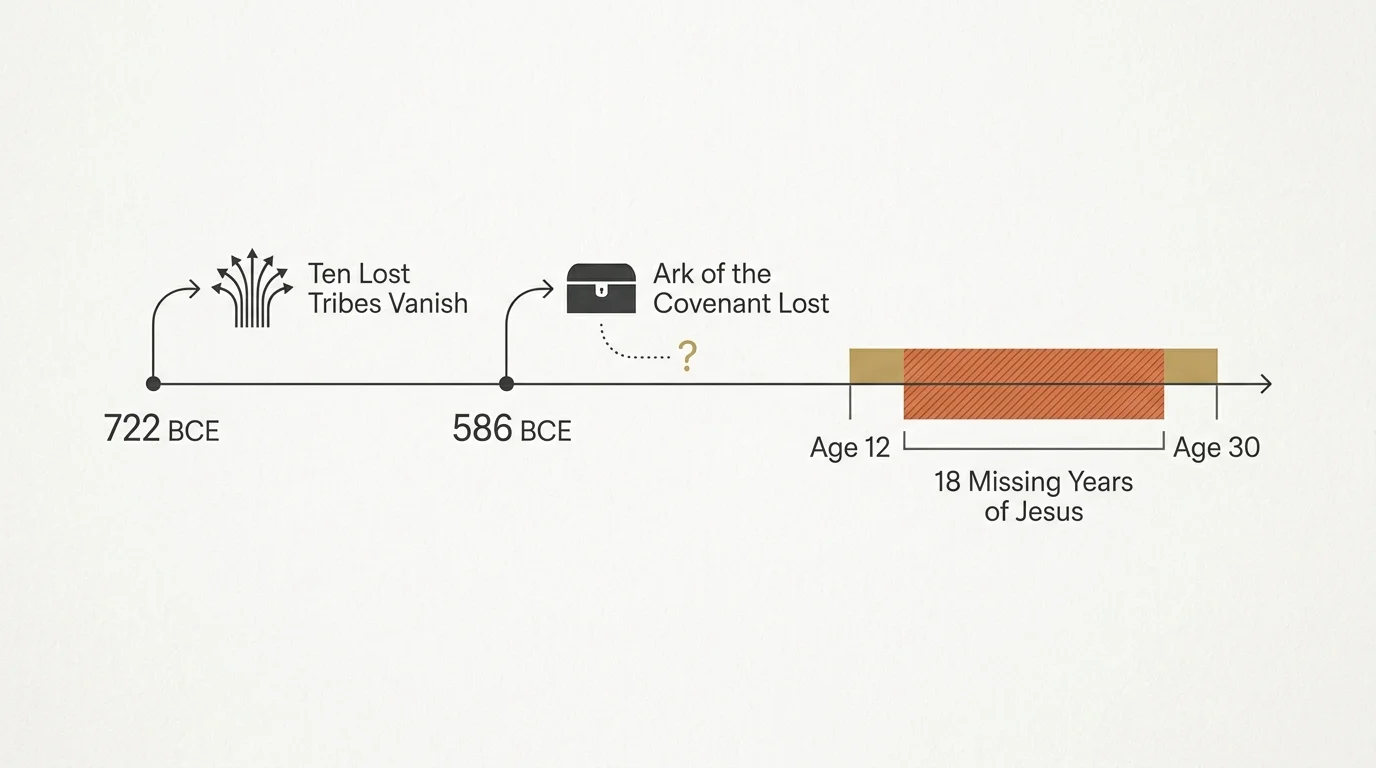
The location of the Ark of the Covenant. The Hebrew Bible abruptly loses track of the sacred Ark after the devastating Babylonian conquest of Jerusalem in 586 BCE. Historians and archaeologists still heavily debate whether the Babylonian military forces systematically destroyed it for its gold or if temple priests managed to smuggle and hide it in an undiscovered, subterranean location.
The authors of the Gospels. The original Greek manuscripts of Matthew, Mark, Luke, and John circulated completely anonymously for several decades before prominent early church fathers formally assigned these specific names to the texts. Modern literary scholars consistently note that the documents themselves do not explicitly identify the individual scribes or community leaders who physically wrote the narratives down.
The fate of the ten lost tribes. After the brutal Assyrian Empire conquered the Northern Kingdom of Israel around 722 BCE, the ten distinct tribes residing within that territory vanished completely from mainstream biblical history. This massive historical blind spot has continuously spawned countless fascinating theories regarding their eventual global migration and their complex assimilation into other ancient surrounding cultures.
The identity of the Nephilim. The Book of Genesis briefly and mysteriously mentions the Nephilim as the formidable offspring resulting from the union of the sons of God and the daughters of men. Academic biblical scholars continue to fiercely argue whether these imposing beings represent fallen angels, ancient deified human kings, or an entirely distinct biological species of ancient mythic warriors.
The missing years of Jesus. The Gospel of Luke dramatically skips directly from a narrative of Jesus at age twelve teaching in the temple to his sudden public baptism at age thirty, leaving eighteen highly formative years completely unaccounted for. You will find absolutely no canonical historical records explaining his formal education, his potential extensive travel, or his detailed occupational training during this lengthy period.
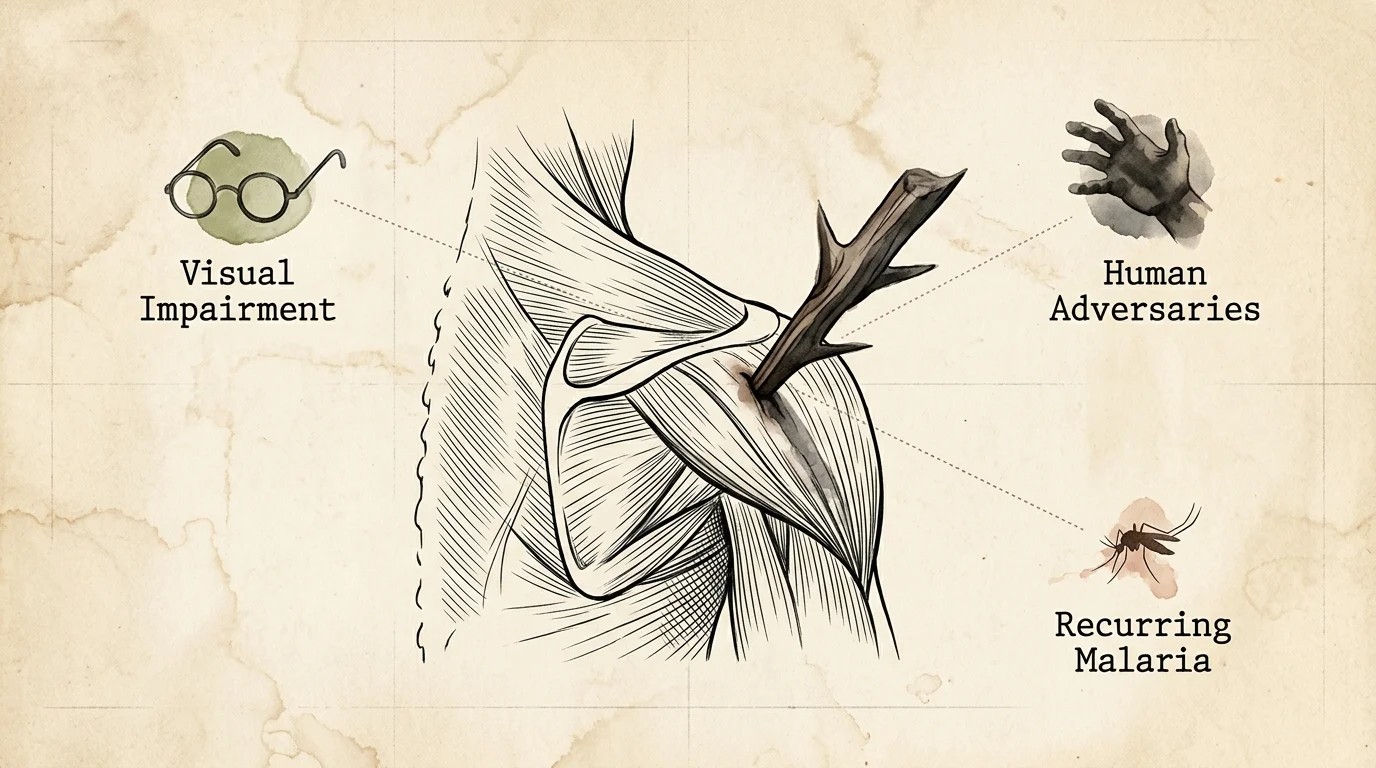
The definition of the Apostle Paul’s thorn in the flesh. The Apostle Paul famously writes about enduring a severely debilitating thorn in the flesh, but he intentionally never specifies the exact physiological or psychological nature of this chronic affliction. Medical researchers and theologians propose varying possibilities ranging from chronic visual impairments and recurring malaria to intense spiritual demonic struggles or highly specific, relentless human adversaries.
The origins of Cain’s wife. The text of Genesis clearly states that Cain married a woman and built a thriving city immediately after his divine exile, yet the preceding narrative only explicitly lists Adam, Eve, Cain, and Abel up to that exact chronological point. This glaring missing genealogical link forces modern readers to infer the existence of unnamed, unmentioned siblings or the presence of entirely separate, concurrent early human populations.
The location of the Garden of Eden. The biblical text names four specific rivers intersecting at the geographic site of Eden—the Tigris, the Euphrates, the Pishon, and the Gihon—but massive geological shifts make pinpointing the exact ancient geographic site virtually impossible today. You simply cannot accurately map this specific location using any modern topographical data, leaving its existence as a purely theological or mythological landmark for many contemporary scholars.
The exact date of the Exodus. The biblical historical timeline provides deeply conflicting chronological clues regarding the massive Israelite departure from Egyptian slavery, causing archaeologists to debate fiercely between a 15th-century BCE or a much later 13th-century BCE date. Furthermore, extensive archaeological excavations throughout Egypt and the Sinai Peninsula lack any definitive, universally accepted evidence linking Ramses II or other specific historical pharaohs directly to the spectacular Exodus event.
Context and Background
When you delve into the origins of the universe as presented in the biblical text, you immediately confront the massive theological mystery of what existed before the events of Genesis. The narrative confidently begins with the creation of the heavens and the earth, but it provides no philosophical framework for the preceding eternity. This omission leaves a towering question regarding the exact state of the cosmos and the divine presence prior to the existence of matter. You are forced to look outside the canon toward later philosophical constructs, such as the doctrine of creation out of nothing, to fill the narrative void. The ancient Hebrew authors showed zero interest in detailing the pre-creation mechanics, focusing instead on establishing a functional order for human existence.
As the biblical timeline enters the period of national formation, historical identification introduces another major unanswered question regarding the identity of the specific Pharaoh of the Exodus. The Book of Exodus exhaustively details the epic liberation of the Israelites from Egyptian bondage, yet it persistently refers to the primary antagonist merely as Pharaoh. By intentionally omitting a specific throne name, the ancient scribes prevent you from easily aligning the Exodus narrative with a definitive, verifiable Egyptian dynasty. You must rely on scattered circumstantial archaeological evidence to argue for either a 15th-century BCE date involving Thutmose III or a 13th-century BCE date implicating Ramses II. The text treats the Egyptian ruler as an archetypal figure of human rebellion rather than a historical data point, leaving his true identity permanently obscured.
The historical reality surrounding the Exodus poses another profound puzzle regarding the sheer logistical scale of the Israelite migration. The biblical text claims that six hundred thousand men on foot, alongside women and children, departed from Egypt, suggesting a total migrating group of over two million individuals. The text miraculously sustains this massive population with divine manna, but it completely skips over the natural sanitary and social logistics required to move a group the size of a modern metropolis through an ancient desert. Modern demographic experts note that a migration of this magnitude would leave an unmistakable physical footprint of camps and refuse across the desert, yet the sands remain totally silent regarding their specific route.
The era of the united Israelite monarchy introduces profound geographical and economic mysteries, specifically surrounding King Solomon’s legendary wealth and the lost region of Ophir. The historical books of the Old Testament state that Solomon imported massive, unprecedented quantities of gold, silver, and exotic goods like ivory and peacocks from this specific region. However, despite centuries of intense geographical exploration and archaeological surveying, modern researchers remain entirely unable to definitively locate Ophir on any map. Scholars propose varying regions ranging from the southwestern Arabian Peninsula to the Horn of Africa, or even reaching as far as the Indian subcontinent. The total inability to map this vital, ancient economic hub leaves the true scale and logistical reach of Solomon’s economic empire completely unverified by outside sources.
Furthermore, the specific mechanisms of divine intervention and prophetic communication remain entirely hidden from the reader throughout the canon. The major and minor prophetic books repeatedly utilize the standard phrase that the word of the Lord came to an individual, but they systematically fail to describe the actual neurological, physiological, or psychological reality of this divine encounter. You are left wondering if esteemed prophets like Isaiah, Jeremiah, or Ezekiel heard audible, external voices, experienced overwhelming internal psychological convictions, or deciphered complex visual symbols during altered trance states. The text presents the reception of divine revelation as an established fact without offering any scientific or practical explanation of how the fragile human mind successfully processed eternal divine communication.
Finally, the aftermath of major divine judgments leaves lingering physical mysteries, most notably the ultimate fate of the Tower of Babel. The Genesis story efficiently explains the sudden diversification of human languages and the subsequent global scattering of early civilizations, but it completely abandons the physical architectural structure itself. You never learn whether the ambitious ancient builders eventually repurposed the massive ziggurat, whether divine forces physically dismantled the brickwork to prevent further rebellion, or if the towering monument simply fell into ruin over centuries of environmental neglect. The narrative utilizes the tower merely as a theological catalyst for human dispersion, leaving the actual physical ruins lost to the sands of the ancient Near East.
Interesting Connections
The historical transition between the close of the Hebrew Bible and the opening chapters of the New Testament introduces a massive chronological and narrative void, generating the question of what exactly transpired during the four hundred years of silence. Protestant biblical canons strictly exclude the deuterocanonical books, meaning the violent events surrounding the Maccabean Revolt, the intense Hellenization of Judea, and the sudden emergence of highly influential religious sects like the Pharisees and Sadducees occur entirely off-page. When you read chronologically from Malachi to Matthew, you step into a radically transformed, highly volatile political landscape without any internal textual bridge to guide you. You have to step outside the primary canon and consult ancient secular historians like Flavius Josephus or dig into apocryphal literature to understand how the Jewish people navigated sweeping Greek and Roman occupations during this silent era.
During the public ministry of Jesus, the gospel narratives record various mysterious actions, but none stand out quite like the incident involving the woman caught in adultery. The Gospel of John vividly describes a highly tense standoff where Jesus unexpectedly bends down and begins writing in the dirt with his finger while the hostile religious authorities demand a harsh legal verdict. The author meticulously records this specific, deliberate physical action but intentionally withholds the actual content of the writing from the reader. You will never know whether he strategically listed the private sins of the aggressive accusers, quoted a specific ancient scripture regarding justice, or merely doodled in the dust to de-escalate the rising mob mentality. This textual silence forces every generation of readers to project their own theological interpretations onto the blank canvas of the dirt.
The post-resurrection narratives introduce a profound psychological mystery regarding why the closest followers of Jesus consistently failed to recognize him immediately. In multiple gospel accounts, individuals who spent years traveling intimately with Jesus look directly at his resurrected form and mistake him for a stranger or a local gardener. The Gospel of Luke details a lengthy walk on the road to Emmaus where disciples converse extensively with him for hours without realizing his true identity. The text refuses to explain whether his facial features physically transformed, whether a divine illusion actively clouded their vision, or if the sheer trauma of the crucifixion altered their psychological ability to process his presence.
Following the expansive missionary journeys of the early church, the authorship of certain foundational theological texts remains stubbornly anonymous, creating the massive literary mystery of who actually wrote the Book of Hebrews. This document stands as an absolute masterclass in first-century Jewish-Christian theology, successfully linking the sacrificial system of the Old Testament to the ultimate priesthood of Christ, yet it lacks any traditional signature or explicit claim of authorship. While medieval church tradition comfortably and universally attributed the sophisticated letter to the Apostle Paul, modern linguistic experts quickly recognize that the highly refined Greek vocabulary, the distinctly elegant rhetorical style, and the unique thematic focus differ drastically from Paul’s verified epistles. The text clearly originated from a brilliant, exceptionally educated early Christian mind—perhaps Apollos, Barnabas, or Priscilla—whose true identity the sands of time have permanently erased.
The final chapters of the biblical canon propel you into the highly complex, symbolic world of apocalyptic literature, where the Book of Revelation guards one of the most explicit secrets in the entire text. During a massive cosmic vision, the author, John, hears the voices of seven mysterious thunders uttering specific messages regarding the unfolding of the end times. In a jarring, unprecedented narrative twist, just as John prepares to record the message, a commanding heavenly voice explicitly orders him to seal up what the thunders said and strictly forbids him from writing the words down. This deliberate act of divine censorship cements a permanent, unsolvable mystery within the canon. You possess the documentation that a profound cosmic message was spoken, but the text flatly denies you any access to its actual prophetic content.
Ultimately, the entire biblical narrative builds toward a climactic cosmic resolution while refusing to answer the single most highly anticipated question: exactly when will the end of the world occur? The gospel texts record Jesus explicitly and categorically stating that the precise day and hour of the apocalyptic end times remain totally unknown to humanity, the angelic host, and shockingly, even to the Son himself. This definitive theological boundary permanently prevents you from accurately mapping out a predictive historical timeline for the apocalypse. Despite this incredibly clear textual prohibition, the glaring absence of a specific date has never stopped subsequent generations of theologians, cult leaders, and enthusiastic believers from attempting to crack a prophetic code that the Bible explicitly claims does not exist.
Frequently Asked Questions
Why does the Bible deliberately leave so many important historical details out of its narratives? Ancient biblical authors heavily prioritized theological meaning and moral instruction over comprehensive historical documentation. You must understand that these scribes wrote specifically to shape the evolving faith and cultural identity of their local communities, not to satisfy modern journalistic standards or contemporary scientific curiosity. By focusing intensely on the overarching relationship between humanity and the divine, the original writers intentionally bypassed secular historical details, precise chronological dates, and scientific mechanics that did not directly serve their central religious narrative. The text functions primarily as a theological guidebook rather than an exhaustive encyclopedia of the ancient world.
Do these massive unanswered questions prove the biblical text is historically unreliable? Textual gaps, scientific blind spots, and historical omissions do not necessarily equate to overall historical unreliability; rather, they accurately reflect the specific literary genres and cultural contexts of the ancient Near East. Professional historians and literary critics fully expect ancient foundational documents to contain inherent biases, localized perspectives, and significant narrative omissions. Acknowledging these fascinating unanswered Bible mysteries actually allows you to engage with the sacred text much more authentically. It encourages you to evaluate the text’s profound moral and theological claims on its own terms, without forcing the ancient manuscript to function as a flawless, modern historical textbook.
Will future archaeological excavations eventually answer all of these remaining biblical mysteries? While ongoing, groundbreaking excavations across the Middle East continually illuminate the broader cultural and political background of the biblical world, physical archaeology simply cannot resolve every textual mystery. Tangible physical evidence often successfully confirms ancient trade routes, long-lost city locations, and the historical existence of certain political figures, but the discipline heavily struggles to verify private spiritual events, unrecorded private conversations, or supernatural theological claims. You will inevitably find that some of these massive questions, particularly those involving miraculous occurrences, divine communication, or deliberate narrative censorship by the original authors, will permanently remain outside the operational scope of empirical scientific verification.
