

Time fundamentally dictates every aspect of your existence, yet physics reveals it is nothing more than a flexible, highly subjective illusion. You will discover that gravity stretches moments, velocity warps aging, and your brain constantly fabricates the present moment to maintain your sanity. Understanding the relativistic nature of the universe completely shatters the traditional concept of past, present, and future. Exploring these time facts offers a radical shift in perspective, stripping away everyday assumptions to reveal a fluid reality. Whether you measure moments through atomic precision or biological rhythms, the fundamental mechanics of the cosmos operate on rules that defy common sense. Let these insights reshape your understanding of existence.
Fast Facts
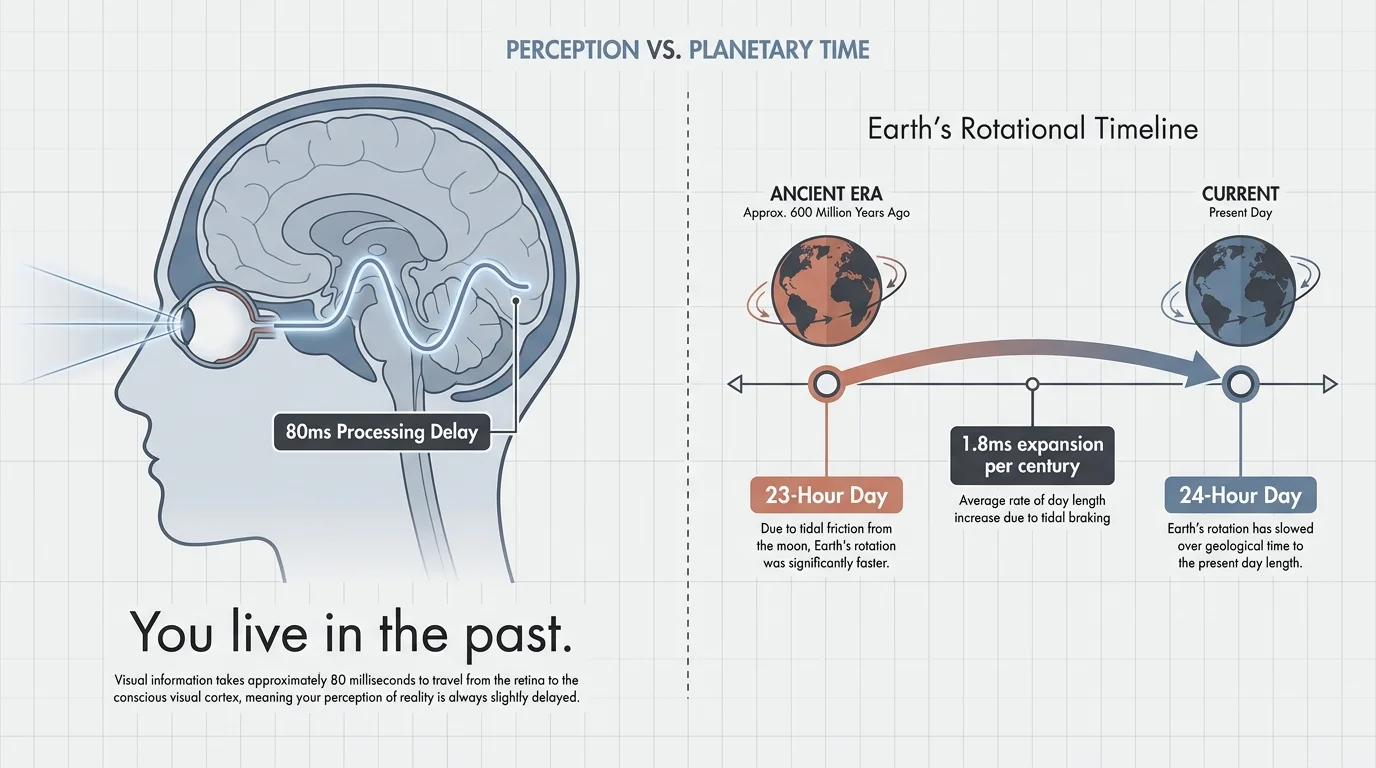
Your brain processes incoming sensory information with an approximate eighty-millisecond delay, meaning you technically live your entire life in the past. This unavoidable neurological lag happens because your conscious mind requires a fraction of a second to stitch together visual, physical, and auditory inputs into a cohesive experience. By the time you consciously perceive an event unfolding in front of you, the physical universe has already moved forward without you.
Gravity actively warps the fabric of spacetime, causing time to move measurably faster at higher elevations compared to sea level. If you live your entire life on top of a tall mountain, you age slightly faster than someone living in a coastal valley; a fact continuously verified by atomic clocks. Earth’s molten core is actually two and a half years younger than its crust because the intense mass at the center of the planet drags time to a slower crawl.
The length of a typical day on Earth slowly expands by about 1.8 milliseconds every century due to the moon’s gravitational pull on our oceans. Tidal friction acts like a massive planetary brake pad against the rotation of the globe, gradually transferring rotational energy outward into space. During the ancient era when dinosaurs dominated the landscape, Earth spun significantly faster, and a standard day lasted roughly twenty-three hours.
The stars you see blazing in the night sky represent ancient history rather than a live broadcast of the current cosmos. Sunlight takes exactly eight minutes and twenty seconds to reach your eyes across the vacuum of space, meaning if the sun suddenly vanished, you would remain blissfully ignorant of the catastrophe for over eight minutes. When you observe distant galaxies through a telescope, you literally gaze millions of years backward into deep cosmic time.
Spacetime operates under a strict universal speed limit, meaning traveling faster through space inherently requires you to travel slower through time. Astronauts aboard the International Space Station orbit the planet at incredible velocities, resulting in a microscopic time dilation effect that makes them age a fraction of a second slower than the rest of humanity. This strange velocity-based warping guarantees that high-speed space travel inherently doubles as a form of forward time travel.
The smallest physically meaningful measurement of duration is the Planck time, which equals approximately ten to the power of negative forty-four seconds. Quantum physics dictates that intervals shorter than this staggering fraction of a second lose all mathematical meaning, representing the foundational frame rate of reality itself. You cannot experience, measure, or conceptualize anything faster, as the known laws of physics completely break down beyond this subatomic threshold.
A bizarre psychological glitch called chronostasis tricks your brain into thinking a ticking clock has momentarily stopped working when you quickly dart your eyes toward it. Saccadic masking occurs during these rapid eye movements, prompting your brain to essentially pause your visual perception and fill the sensory gap with the first stable image you see. This retroactive editing of your sensory feed provides compelling trivia regarding how fragile human time perception actually is.
Entropy dictates the irreversible arrow of time, ensuring that the entire cosmos moves strictly from an organized state toward complete disorder. You can easily scramble a raw egg, but you can never unscramble it into a perfect shell; a macroscopic reality driven entirely by the unforgiving laws of thermodynamics. This foundational physical asymmetry remains the only definitive, scientific reason you vividly remember the past but cannot remember the future.
Absolute simultaneity represents a total physics myth, meaning two events happening at the exact same moment for you might happen at vastly different times for an observer moving at a different speed. Albert Einstein proved that the concept of “now” is entirely local and subjective, lacking any universal master clock to synchronize events across the void. Your current moment holds no special chronological authority over the timeline of an alien civilization observing Earth from a distant galaxy.
[INSERT AD HERE]
Context and Background
Physics fundamentally divides the concept of time into two distinct eras: classical mechanics and modern relativity. Before the twentieth century, brilliant minds like Isaac Newton treated time as a rigid, unyielding stage upon which the events of the universe simply unfolded. Newton insisted that seconds ticked away uniformly for every entity in existence, entirely independent of speed, mass, or physical location. This comfortable, intuitive model perfectly matched daily human observation and allowed early engineers to build functioning societies, map the stars, and construct complex industrial machines. However, classical mechanics completely failed to explain the bizarre, constant speed of light, setting the stage for a scientific revolution that would rewrite the underlying code of reality.
Albert Einstein introduced Special Relativity in 1905, obliterating the Newtonian idea of a universal clock and delivering some of the most profound science facts ever conceived. Einstein realized that the speed of light remains locked at a constant rate for all observers, demanding that space and time must bend and flex to accommodate this universal law. Time became a physical dimension inextricably entangled with three-dimensional space, forming a four-dimensional fabric called spacetime. As your velocity increases, time stretches out—a mathematical reality proving that moving clocks tick significantly slower than stationary ones. Einstein expanded this concept a decade later with General Relativity, proving that massive objects curve spacetime, causing gravity to further distort the chronological flow.
You can easily see the tangible results of these theoretical frameworks in modern atomic timekeeping. The National Institute of Standards and Technology (NIST) operates ultra-precise atomic clocks that measure time by observing the incredibly stable, predictable vibrations of cesium and strontium atoms. These technological marvels keep time so accurately that they will neither gain nor lose a single second over tens of millions of years. Physicists use these hyper-sensitive instruments to prove that time dilation happens constantly here on Earth. If you lift an atomic clock just a few feet off the laboratory floor, it immediately measures a slightly faster passage of time because it has moved infinitesimally further away from Earth’s gravitational center.
Thermodynamics provides another crucial pillar for understanding the architecture of existence, specifically through the unrelenting concept of entropy. The Second Law of Thermodynamics dictates that closed systems naturally progress from structural order to chaotic randomness, establishing what physicists call the arrow of time. This physical law governs why a dropped coffee mug shatters into chaotic fragments, yet those fragments will never spontaneously reassemble themselves into a pristine cup. You experience the forward march of reality strictly because the overall disorder of the universe continuously increases. While the mathematical equations governing quantum particles often function perfectly whether time runs forward or backward, everyday macroscopic reality remains fiercely directional due to this unavoidable entropic drift.
[INSERT AD HERE]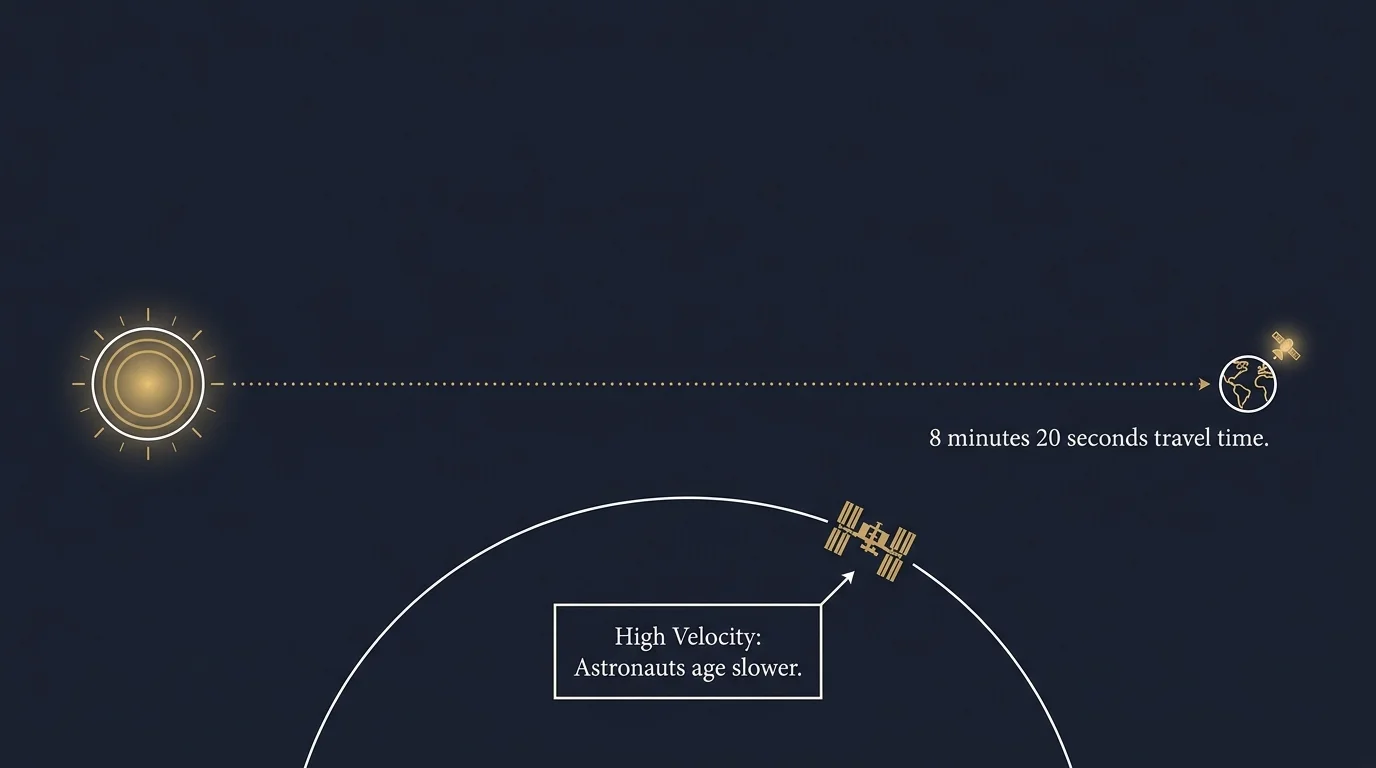
Interesting Connections
Your biological machinery operates entirely on internal clocks, seamlessly linking human anatomy to the rhythmic cycles of the solar system. The suprachiasmatic nucleus—a tiny cluster of thousands of highly specialized cells located deep within your hypothalamus—serves as your body’s master timekeeper. This biological metronome heavily relies on environmental light cues to synchronize your circadian rhythms, directly dictating your sleep patterns, daily hormone production, and core body temperature. When you cross multiple time zones during an international flight, your master clock instantly falls out of sync with your new physical environment. This sudden neurological desynchronization causes the exhausting, disorienting symptoms of jet lag. You can actively manage your biological time by deliberately exposing yourself to bright morning sunlight, effectively resetting your internal pacemaker to optimize your daily energy levels.
Psychological time rarely aligns with the rigid ticking of a mechanical clock, offering fascinating insights into how human memory processes your daily experiences. When you encounter highly novel situations, your brain records immense amounts of high-density sensory data, creating rich, detailed memories that make the duration feel heavily stretched out in retrospect. Conversely, familiar routines require very little active cognitive processing, causing the brain to store drastically fewer memory anchors. This neurological efficiency perfectly explains the common phenomenon where childhood summers felt endless, yet your adult years seem to vanish in the blink of an eye. You can forcefully slow down your subjective perception of time by breaking your daily routines, traveling to unfamiliar locations, and forcing your brain to actively process new stimuli rather than running on comfortable autopilot.
Technological infrastructure heavily depends on the bizarre truths of relativity to function correctly in modern society. Global Positioning System satellites orbiting the Earth provide pinpoint navigational data directly to your smartphone, but these machines must constantly correct for relativity to remain useful. Because these satellites whip around the planet at roughly fourteen thousand miles per hour, special relativity dictates their onboard clocks should tick slower than ground-based clocks. Simultaneously, general relativity exerts a stronger opposing force; because the satellites orbit thousands of miles away from Earth’s massive gravitational pull, their clocks naturally tick faster. Engineers must program an exact mathematical offset into the satellite software to compensate for this constant chronological drift. Without this mandatory relativistic adjustment, the navigation application on your phone would fail within minutes, misguiding you by miles.
The fundamental architecture of the global internet also requires staggering temporal precision to prevent total systemic collapse. Financial markets, international telecommunications networks, and automated power grids rely on strict Network Time Protocols to synchronize computer systems down to the exact millisecond. When billions of digital transactions occur globally, machines must perfectly agree on the chronological sequence of events to prevent massive data corruption and financial ruin. The National Aeronautics and Space Administration (NASA) faces an even more extreme challenge when coordinating communications across vast interplanetary distances, where radio signal delays stretch from minutes to hours. Establishing a unified, reliable timeline across a solar system bound by the inflexible speed of light remains one of the greatest logistical hurdles in aerospace engineering.
[INSERT AD HERE]Frequently Asked Questions
Can humans ever travel backward through time?
Current mathematical models in theoretical physics strongly suggest that traveling into the past remains completely impossible. While Einstein’s complex equations technically permit the existence of closed timelike curves—theoretical paths through spacetime that loop back on themselves—the immense energy requirements and paradoxical violations of causality make them highly improbable in reality. Bending spacetime into a functional wormhole would require exotic matter featuring negative energy mass; a bizarre substance entirely hypothetical at this stage in human scientific development. Most renowned physicists agree that the universe possesses an inherent chronological protection mechanism, effectively forbidding backward travel to prevent logic-destroying paradoxes like accidentally preventing your own birth.
Why does time seem to speed up as you get older?
The proportional theory of cognitive aging offers the most practical, mathematically sound explanation for this universal sensation. When you are exactly ten years old, a single year represents ten full percent of your entire existence, making it feel incredibly substantial and lengthy. By the time you reach age fifty, one year shrinks to a mere two percent of your total lived experience. Furthermore, standard aging typically brings predictable, repetitive daily routines that demand far less active mental encoding compared to the constant stream of new discoveries experienced during your youth. You continually aggregate fewer distinct memories per year as you age, causing your brain to perceive the passage of those adult years as increasingly rapid.
Is time travel into the future actually real?
You constantly travel into the future at a standard, unavoidable rate of one second per second, but quantum physics allows you to radically accelerate that journey through extreme velocity or intense gravity. If aerospace engineers successfully built a spacecraft capable of reaching ninety-nine percent of the speed of light, you could embark on a one-year interstellar voyage and return to an Earth that has aged several decades in your absence. This form of aggressive forward time travel is a verified, undisputed scientific reality backed by decades of rigorous research. Modern astronauts already achieve this incredible feat on a microscopic scale, technically returning from space a tiny fraction of a second younger than their identical counterparts on the ground.
Does time exist independently of human observation?
Theoretical physicists heavily debate whether time functions as a fundamental property of the cosmos or merely an emergent illusion created by human consciousness navigating complex thermodynamics. Classical relativity treats the universal timeline as a fixed four-dimensional block where the past, present, and future all exist simultaneously in a predetermined, unchangeable structure. Under this block universe theory, your brain simply experiences this static structure slice by slice as you move through life. However, quantum mechanics suggests that temporal flow might arise dynamically from the complex, unpredictable entanglement of subatomic particles. Regardless of the underlying mechanism, the observable, destructive effects of time—such as atomic decay, physical motion, and rising entropy—unquestionably operate independently of human perception, leaving us with mind blowing facts about the fabric of reality.
