

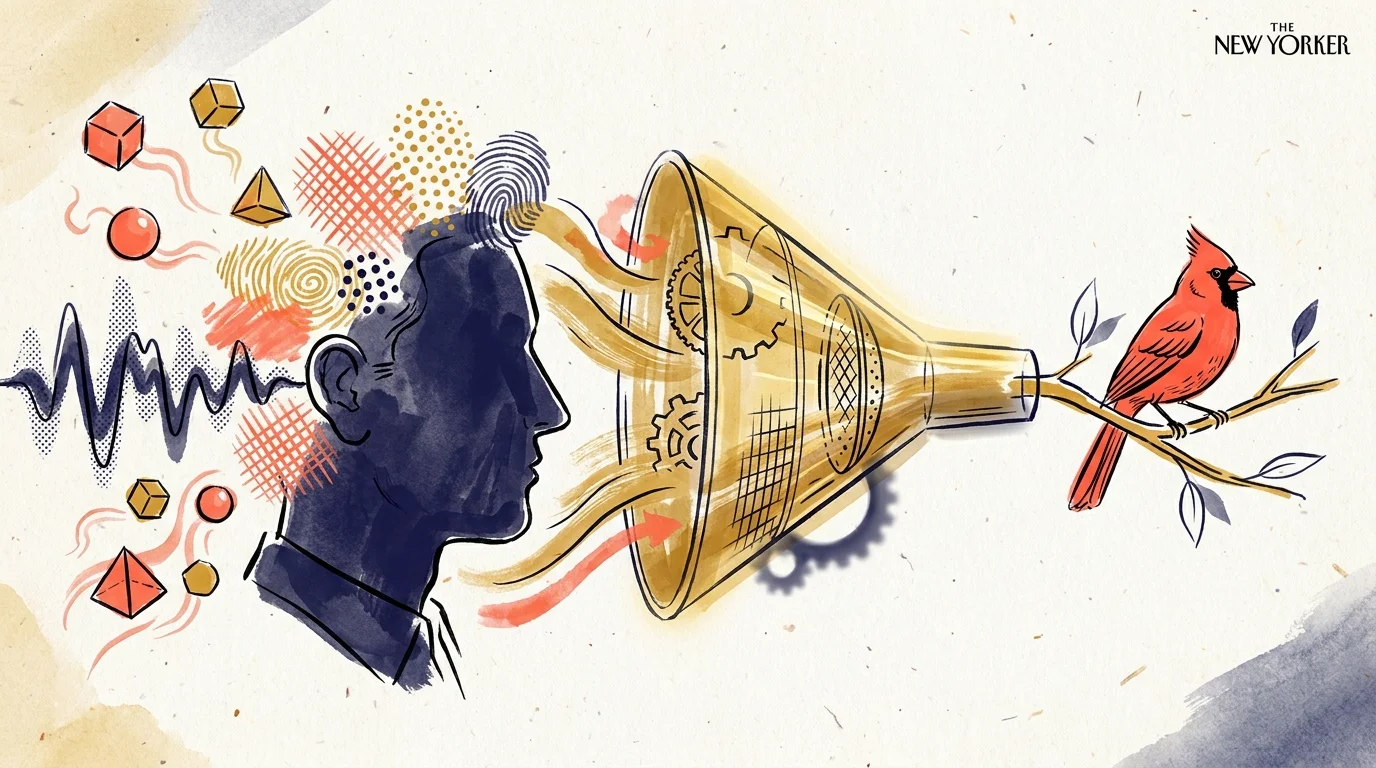
Your perception of reality relies on complex neurological mechanisms that constantly filter and alter data before you consciously register it. Human body facts reveal that your eyes, ears, nose, tongue, and skin gather highly imperfect information, forcing your brain to fill in critical gaps through extraordinary biological adaptations. You actually possess dozens of sensory pathways beyond the classical five, utilizing sophisticated networks like proprioception and thermoception to safely navigate your environment. By understanding how these hidden systems operate, you can recognize exactly why you sometimes hear colors, taste shapes, or miss massive visual changes happening directly in front of you. This intricate sensory architecture aggressively shapes every single decision you make.
Fast Facts
You can track a scent trail through an open field just like a bloodhound. Researchers at the University of California, Berkeley demonstrated that blindfolded humans equipped with knee pads successfully followed chocolate scent trails across a lawn, drastically improving their speed and accuracy with just a few days of consistent practice. This remarkable ability highlights a massive, underutilized olfactory potential residing directly in your nasal cavity.
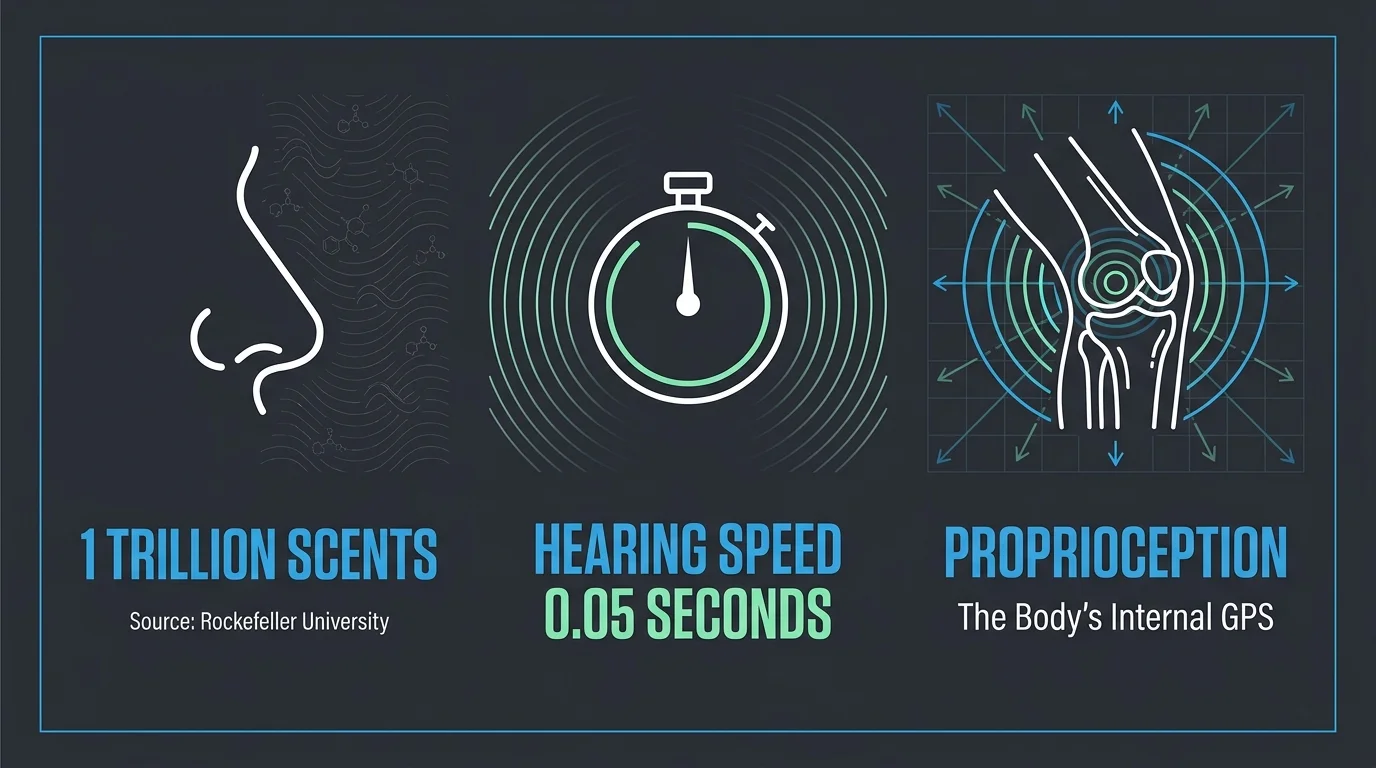
Your nose acts as a supercomputer for airborne chemicals, possessing the biological hardware to distinguish over one trillion distinct scents. A landmark study from Rockefeller University shattered the long-held scientific myth that humans could only identify ten thousand smells, proving your olfactory bulb is remarkably sophisticated. You navigate an incredibly complex chemical landscape every single time you take a breath.
You possess a distinct, vital sense known as proprioception, which functions as your body’s internal GPS system. Specialized mechanical receptors embedded in your muscles, tendons, and joints constantly send positional signals to your brain, allowing you to easily touch your nose with your eyes closed or sprint up a flight of stairs without looking down at your feet. Without this vital sensory feedback loop, coordinating even the simplest physical movements would become completely impossible.
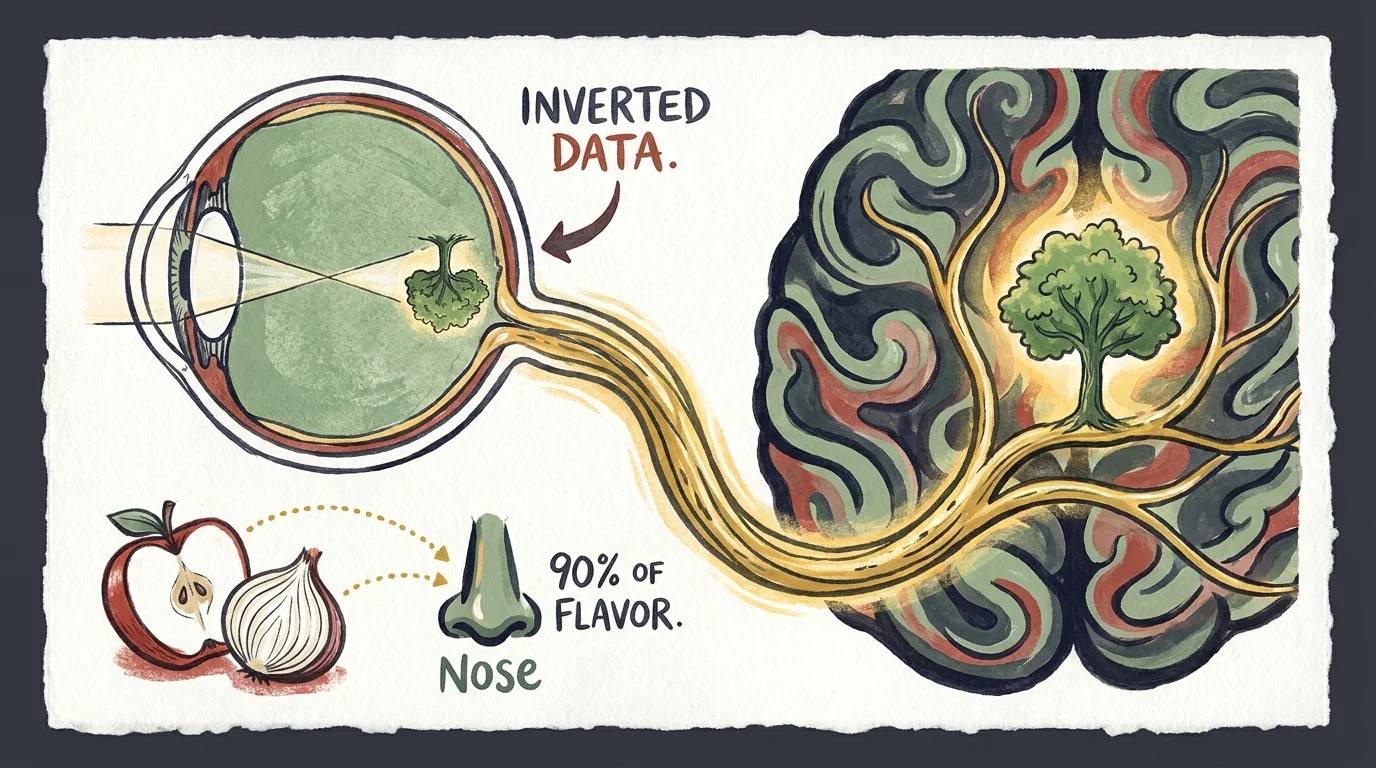
When you bite into a fresh apple or a raw onion, your taste buds execute only a tiny fraction of the sensory work; human flavor perception relies almost entirely on your sense of smell. If you completely block your nasal passages, your tongue can only detect basic profiles like sweet, salty, or bitter, rendering the complex flavors of apples and onions virtually indistinguishable. Your brain seamlessly fuses gustatory and olfactory signals into the single, unified sensation you recognize as flavor.
Hearing operates as your fastest and most highly optimized sense, allowing you to react to auditory stimuli significantly quicker than visual or tactile inputs. Your brain recognizes and begins processing a sound in merely 0.05 seconds—an ancient evolutionary adaptation designed to alert you to unseen predators or immediate dangers in your environment. You literally process the sound of a falling object before your eyes can physically register its movement.
The biological lenses in your eyes project the entire visual world onto your retinas completely upside down. Your visual cortex continuously intercepts and corrects this inverted data in real time, seamlessly flipping the image right-side up before you ever consciously perceive it. This extraordinary neurological processing happens so rapidly and efficiently that you never once notice the raw, upside-down input feeding into your optic nerve.
A rare genetic variation called tetrachromacy grants certain individuals four distinct types of cone cells in their eyes instead of the standard three. This extraordinary biological condition, found almost exclusively in women, enables the perception of up to one hundred million distinct colors, compared to the standard one million seen by average human eyes. You might look at a simple patch of green grass, while a tetrachromat sees a staggering mosaic of vibrant, subtle hues.
Around four percent of the human population experiences synesthesia, a fascinating neurological condition where stimulating one sensory pathway involuntarily triggers a vivid experience in a completely different pathway. This unique cortical cross-wiring allows individuals to physically taste spoken words, associate specific vibrant colors with musical notes, or perceive numbers as having distinct human personalities. The brain essentially dissolves the boundaries between distinct sensory modalities to create a unified, multisensory experience.
Your skin features a specialized, secondary network of nerve fibers called C-tactile afferents that exclusively respond to gentle, comforting touches moving at very specific speeds. Unlike regular nerve endings that detect sharp pressure or sudden pain, these specialized receptors bypass your standard sensory cortex entirely and send electrical signals directly to the emotion-processing centers of your brain. This specific biological mechanism explains why a gentle stroke on the arm immediately reduces your heart rate and effectively lowers your systemic stress levels.
Context and Background
The traditional model of the five human senses traces its origins all the way back to Aristotle, but modern neuroscience has thoroughly dismantled this ancient framework. While educational systems continue to teach the basic concepts of sight, hearing, smell, taste, and touch, clinical researchers recognized decades ago that human body facts support a much broader sensory paradigm. You actually possess up to thirty-three distinct senses that constantly feed critical survival data to your central nervous system. These include thermoception for detecting temperature changes, nociception for processing pain signals, and chronoperception, which allows your brain to track the passage of time. Limiting your understanding to just five senses ignores the massive, invisible data networks keeping you alive and functioning every single day.
One of the most critical hidden senses operating in your body is the vestibular system, which governs your spatial orientation and sense of balance. Deep inside your inner ear, you possess three tiny, fluid-filled semicircular canals arranged at distinct angles. Whenever you tilt your head, accelerate in a car, or spin around, the fluid inside these canals moves, bending microscopic hair cells that immediately fire electrical impulses to your brainstem. This system operates entirely outside of your conscious awareness until it malfunctions. If you experience motion sickness or vertigo, you are witnessing a direct conflict between your visual input and your vestibular data. To optimize your vestibular health, regularly engage in balance-focused activities like yoga or martial arts, which actively calibrate these inner-ear sensors and improve your overall spatial intelligence.
Interoception represents another massive sensory network that you use constantly but rarely acknowledge. This internal monitoring system allows your brain to perceive the physiological condition of your organs, detecting subtle shifts in your heartbeat, respiration rate, and digestive tract. specialized chemoreceptors in your blood vessels continuously track carbon dioxide levels, dictating exactly when you feel the urgent need to breathe. Stretch receptors in your stomach wall inform you when you have eaten enough food. Practical science facts suggest that improving your interoceptive awareness directly benefits your mental health. By practicing mindful breathing and consciously tuning into your heartbeat, you strengthen the neural pathways associated with emotional regulation, allowing you to rapidly de-escalate anxiety and manage acute stress.
To process this overwhelming tsunami of sensory data, your brain operates primarily as a prediction machine rather than a passive receiver. The concept of predictive coding dictates that your brain actively constructs a highly detailed model of the world and uses raw sensory input merely to correct its internal errors. For example, your eyes possess a literal blind spot where the optic nerve connects to the retina, lacking any photoreceptor cells whatsoever. Instead of seeing a black hole in your field of vision, your visual cortex instantly hallucinates the missing details based on the surrounding environment. You do not see the world as it objectively exists; you see an incredibly fast, highly optimized simulation generated by your brain to ensure your immediate survival.
Your nervous system also utilizes sensory adaptation to prevent constant neurological overload. When you encounter a continuous, unchanging stimulus—like the smell of your own house, the feeling of a wristwatch on your arm, or the hum of an air conditioner—your sensory receptors rapidly decrease their firing rate. Your brain intentionally mutes this static information to prioritize detecting sudden, potentially dangerous changes in your environment. If you ever need to evaluate a persistent odor in your home, step completely outside for five minutes to reset your olfactory receptors before returning. This rapid neural recalibration demonstrates just how aggressively your brain edits your perception of reality to maximize processing efficiency.

Interesting Connections
Your olfactory system shares an intimate, unmediated connection with the emotional and memory centers of your brain, creating one of the most powerful sensory phenomena in human biology. When you hear a sound or touch an object, the sensory data travels first to the thalamus—the brain’s central relay station—before being routed to the appropriate processing centers. Smell completely bypasses this relay station. Your olfactory bulb sends signals directly into the amygdala and the hippocampus, the regions entirely responsible for processing intense emotions and episodic memories. This unique neuroanatomical highway explains the Proustian effect, where catching a sudden whiff of a specific perfume, old book, or childhood meal instantly transports you back in time, triggering visceral, fully formed memories that other senses simply cannot access.
The phenomenon of multisensory integration reveals that your senses constantly collaborate, and sometimes compete, to form your perception of reality. The McGurk effect perfectly illustrates this neurological overlap. If you watch a video of a person repeatedly mouthing the syllable “ga,” but the audio track plays the sound “ba,” your brain attempts to resolve the conflicting data by inventing a third sound, causing you to clearly hear “da.” Vision generally dominates your sensory hierarchy, meaning your brain will readily overwrite auditory or tactile information if it conflicts with what you see. You can use this trivia to your advantage: when you need to isolate a specific flavor in a complex meal or pinpoint a faint noise in a crowded room, close your eyes. Removing the dominant visual data forces your brain to allocate more processing power to your secondary senses.
Neuroplasticity allows your brain to perform seemingly impossible feats of sensory substitution, completely rewiring its standard architecture when necessary. If a person loses their sight, the visual cortex does not simply shut down and remain dormant. Instead, it aggressively recruits data from the auditory and tactile systems. Many visually impaired individuals successfully learn human echolocation, producing sharp clicking noises with their tongues and listening to the rebounding sound waves to build a high-fidelity mental map of their surroundings. Functional MRI scans reveal that when these individuals listen to their echoes, their visual cortex actively processes the sound, allowing them to literally see their environment through audio data. This extreme adaptability proves that your sensory centers are defined more by the data they process than by the physical organs that collect it.
The emerging field of chronoperception highlights the complex relationship between your neurochemistry and how you sense the passage of time. Your brain does not possess a single biological clock; instead, it synthesizes timing data from multiple neural circuits heavily influenced by the neurotransmitter dopamine. When you engage in a highly stimulating, novel activity, massive dopamine releases flood your system, causing your brain to compress its internal timing intervals—making hours feel like minutes. Conversely, during moments of acute fear or extreme boredom, dopamine levels drop, causing your brain to record environmental data at a much higher frame rate. This neurochemical distortion ensures you retain maximum information during a crisis, which explains exactly why time seems to crawl to a dead halt during a car accident or a physical fall.
Frequently Asked Questions
Why do educational systems still teach that humans only possess five senses?
The concept of five primary senses originates from ancient Greek philosophy, specifically Aristotelian classifications created thousands of years before the invention of modern medical imaging. Educational frameworks vastly prefer these simplified models because they are highly intuitive and easy to teach to young children. Modern neuroscientists classify a sense by the presence of a distinct type of cellular receptor gathering specific data. Under this strict biological definition, systems that measure internal temperature, physical balance, and pain easily qualify as standalone senses. Schools retain the classical five purely for pedagogical convenience, sacrificing neurological accuracy for classroom simplicity.
Can you actively train your brain to improve your sensory processing?
You can significantly sharpen your sensory processing through deliberate neuroplasticity exercises. By consciously focusing on isolated stimuli—such as identifying specific individual spices in a complex curry or distinguishing the bass guitar track from the rest of a musical recording—you force your brain to strengthen the neural pathways associated with those specific inputs. You do not physically change the density of the receptors on your tongue or inside your ear, but you dramatically improve your brain’s software. Exposing yourself to novel, sensory-rich environments actively fortifies these pathways, enhancing your overall cognitive flexibility and perceptual acuity.
What exactly happens in your brain when you permanently lose a primary sense?
When a primary sensory input ceases entirely, your brain undergoes a massive structural reorganization known as cross-modal plasticity. Your brain is a highly efficient organ that refuses to let valuable cortical real estate sit idle. The neurons previously dedicated to processing the lost sense get rapidly colonized by your remaining senses. For instance, the auditory and tactile systems quickly expand into the visual cortex in completely blind individuals, significantly enhancing their hearing resolution and touch sensitivity. The brain permanently reallocates its processing power to maximize the efficiency of the physical data it can still acquire.
How does sensory overload physically impact your central nervous system?
Sensory overload triggers an acute, systemic stress response when your brain receives vastly more simultaneous data than it can actively process. When you walk into a room with blinding lights, overlapping loud noises, and dense crowds, your processing centers bottleneck. Your amygdala interprets this severe data traffic jam as a direct physical threat, instantly initiating a fight-or-flight biological cascade. Your heart rate violently elevates, cortisol floods your bloodstream, and you experience intense psychological anxiety. This is a biological defense mechanism forcing you to immediately retreat from the overstimulating environment to restore your neurological baseline.
Why do your flavor preferences change so drastically as you age?
Your taste buds naturally regenerate roughly every two weeks, but this cellular replacement cycle slows down significantly as you grow older. Concurrently, your delicate olfactory receptors steadily degrade, which severely mutes your ability to perceive complex, subtle flavor profiles. Because human flavor relies so heavily on smell, this dual degradation forces your brain to seek out much stronger stimulation to register any satisfying response. You naturally begin gravitating toward bolder, heavier profiles—especially intensely sweet, spicy, and salty foods—because your aging sensory hardware literally requires a higher volume of chemical data to trigger the same pleasure response you experienced in your youth.
Can you completely trust the information your senses provide?
You should maintain a healthy, persistent skepticism regarding your sensory data. Your brain constantly filters, alters, and completely invents information to construct a coherent, manageable narrative of reality. Optical illusions easily hack your visual cortex by exploiting its predictive algorithms, while auditory hallucinations demonstrate how your brain can effortlessly generate loud sounds without any external stimuli. Your everyday perception represents an educated, highly edited guess optimized strictly for biological survival, rather than a high-fidelity video recording of objective, absolute truth. Trusting your senses requires understanding their inherent, evolutionary limitations.
