

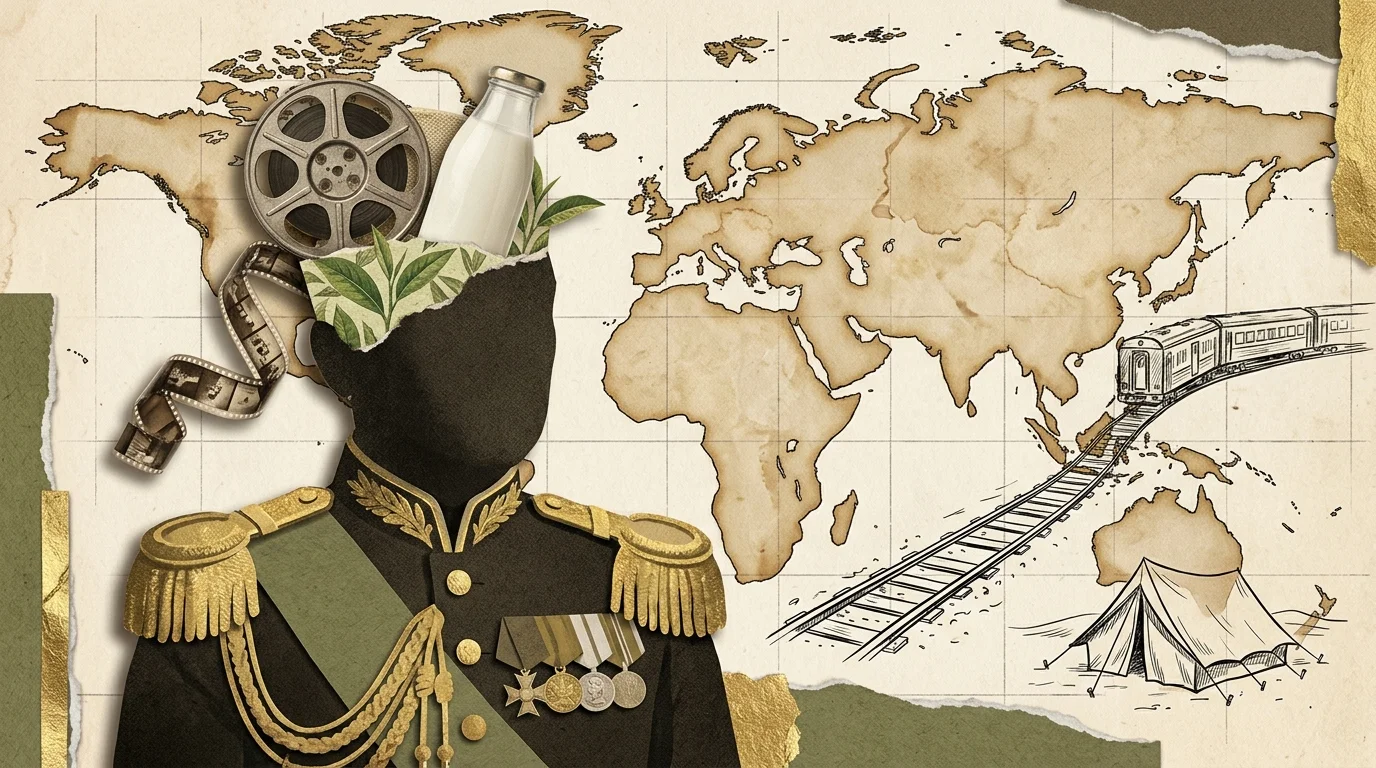
Exploring the private lives of famous dictators reveals bizarre daily routines that starkly contrast their terrifying public personas. When you study world history, you often focus on sweeping geopolitical events, entirely missing the strange idiosyncrasies of these political leaders. Understanding these oddities gives you a more complete psychological profile of historical figures who held absolute power. From extreme germaphobia and strange dietary fixations to compulsive movie watching and imaginary titles, their habits highlight how unchecked authority breeds eccentricity. By examining these unusual routines, you gain deep insight into the surreal realities they constructed. You will see firsthand how absolute control distorts everyday behavior, transforming mundane habits into bizarre expressions of absolute supremacy.
Fast Facts
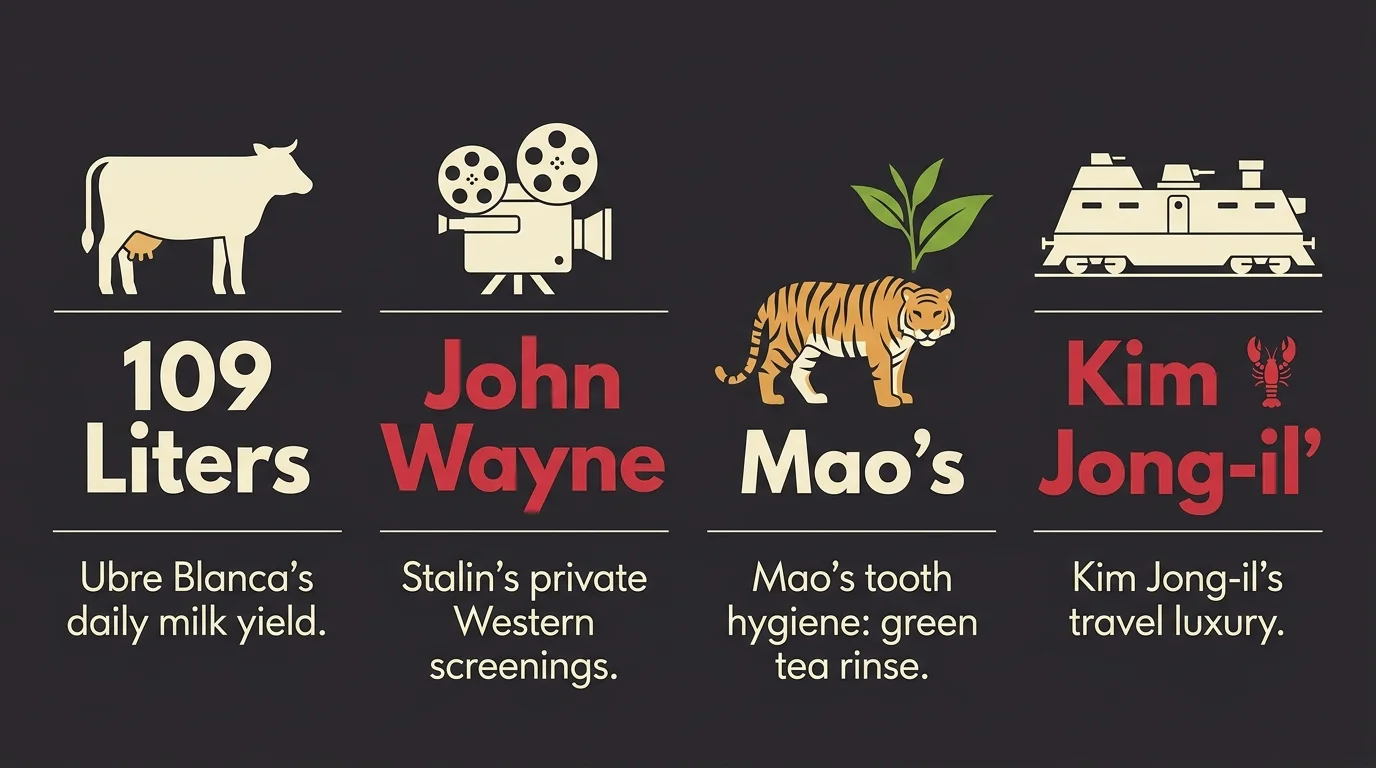
Fidel Castro cultivated an overwhelming fixation on dairy products that bordered on a manic obsession, leading him to invest massive national resources into Cuba’s agricultural sector. He desperately wanted to breed a specialized super cow capable of outproducing American cattle, ultimately resulting in a famous genetically modified cow named Ubre Blanca that yielded an astonishing 109 liters of milk in a single day. When you examine this habit, you realize Castro used ice cream consumption and dairy production as a bizarre proxy war to demonstrate communist superiority over capitalist agricultural systems.
Joseph Stalin compulsively screened American Westerns in his private Kremlin cinema, regularly acting as his own projectionist while forcing his terrified inner circle to endure these late-night movie marathons. He loved the macho bravado of actors like John Wayne and directed his translators to dub the dialogue live, even though he actively banned the Soviet public from watching the exact same Western films. You can identify the immense hypocrisy of a dictator who greedily consumed the cultural products of his greatest geopolitical enemy while strictly denying that same privilege to the millions of citizens living under his iron-fisted rule.
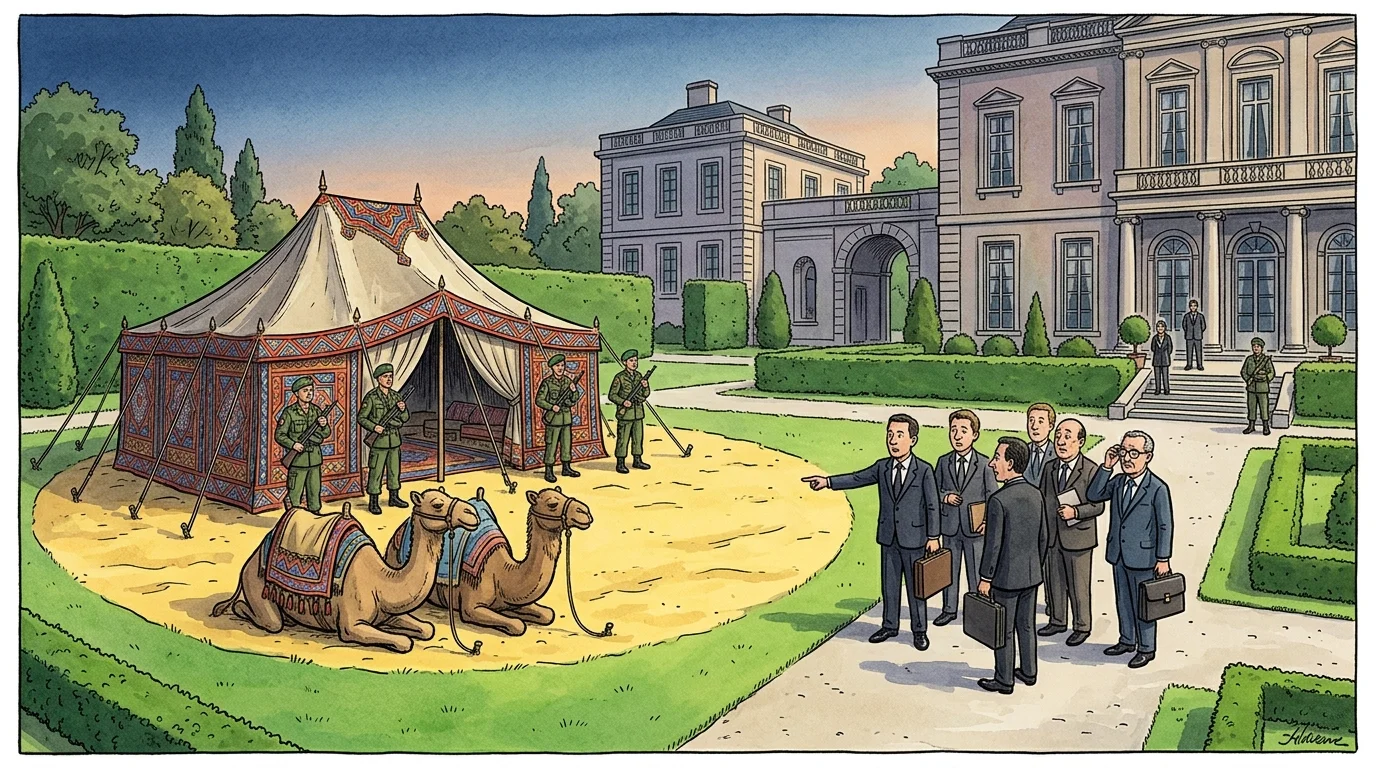
Muammar Gaddafi adamantly insisted on sleeping in a heavily guarded, bulletproof Bedouin tent during his foreign travels, often demanding permission to pitch the massive structure in the manicured gardens of lavish European estates and luxury hotels. He filled this extravagant tent with imported sand and live camels to recreate the Libyan desert aesthetic, forcing foreign dignitaries to conduct official state business in a highly theatrical setting. This habit allowed Gaddafi to project a specific image of nomadic authenticity, purposefully disorienting Western diplomats while physically grounding himself in an artificial, portable version of his homeland.
Kim Jong-il harbored an intense, paralyzing fear of flying that forced him to travel exclusively by heavily armored luxury trains whenever he conducted state visits to China or Russia. His bespoke train featured lavish reception rooms, secure conference cars, and live lobsters flown in daily to satisfy his extravagant culinary tastes while he traversed the countryside. Because his train moved incredibly slowly to scan for explosives along the tracks, you can see how his personal phobia caused massive logistical nightmares, completely paralyzing the entire railway infrastructure of whatever country he happened to traverse.
Mao Zedong vehemently refused to use a modern toothbrush, opting instead to rinse his mouth with green tea and chew the loose leaves to clean his teeth. When his personal physician warned him about severe tooth decay and impending gum disease, Mao quickly dismissed the medical advice by loudly asking if tigers ever brushed their teeth. This blatant disregard for basic modern hygiene left his teeth coated in a thick green film and rotting from the gums down, perfectly illustrating how an arrogant belief in personal invincibility completely overrides basic common sense and established medical science.
Nicolae Ceaușescu operated as an extreme germaphobe who mandated that his security detail rigorously wipe his hands with strong medical alcohol immediately after he shook hands with any foreign dignitaries. He also refused to wear any article of clothing more than once, ordering his staff to incinerate his bespoke suits at the end of every single day to prevent mysterious assassinations by poisoned or irradiated fabric. This relentless paranoia highlights how dictatorial isolation breeds severe pathological anxieties, trapping the leader in a self-constructed psychological prison where they remain permanently terrified of invisible, microscopic threats.
François Duvalier, widely known as Papa Doc, modeled his entire public appearance on the traditional voodoo spirit of death, Baron Samedi, wearing a heavy dark suit and a top hat to deliberately terrify the deeply superstitious Haitian population. He purposefully changed his voice to a nasal whisper to mimic the spirit, successfully convincing many citizens that he possessed authentic supernatural powers and could read their innermost thoughts. By intentionally merging his political persona with religious mythology, you witness a chillingly effective strategy where a leader weaponizes local theology to enforce absolute compliance and paralyzing public fear.
Idi Amin routinely awarded himself grandiose and entirely imaginary titles, culminating in his absurd declaration that he was the Uncrowned King of Scotland and the Conqueror of the British Empire. He took this fantasy so far that he forced prominent white expatriates living in Uganda to carry him through the streets on a literal throne, ensuring international photographers captured the humiliating spectacle. When you analyze this theatrical behavior, you uncover a deep-seated inferiority complex masked by bombastic displays of dominance designed specifically to mock his former colonial masters and project an illusion of supreme global authority.
Saparmurat Niyazov, the totalitarian ruler of Turkmenistan, completely rewrote the national calendar by officially renaming the months of the year and the days of the week after himself, his mother, and various philosophical concepts from his own published manifesto. He aggressively banned citizens from having gold teeth, listening to recorded music, or wearing makeup, ruthlessly micromanaging the minutiae of everyday life across the entire nation. This staggering level of governmental overreach proves that when a leader actively destroys all institutional boundaries, they inevitably attempt to reshape the foundational reality and daily habits of their captive population.
Adolf Hitler maintained a profoundly erratic daily schedule, routinely staying awake until dawn to obsessively watch movies and then sleeping well into the late afternoon while his military staff waited in paralyzing fear outside his bedroom. He particularly enjoyed watching Mickey Mouse cartoons and actively banned American films in public while hoarding them for his private, late-night screenings at his mountain retreat. You can trace significant military blunders directly to this sleep habit, notably during the D-Day invasion when terrified German generals refused to wake him, delaying crucial panzer tank deployments that could have altered the battlefield.
Context and Background
To fully grasp why these famous dictators developed such bizarre routines, you must first understand the devastating psychological impact of absolute power. When a leader violently removes all democratic checks and balances, they inherently destroy their connection to objective reality. In any normal environment, friends, family members, or colleagues quickly point out strange or alienating behaviors. However, a dictator surrounds themselves exclusively with sycophants who validate their every whim under the constant threat of execution. You can recognize this phenomenon, often called the dictator trap, as a severe echo chamber where eccentricities blossom into rigid, unbreakable laws. As isolation increases, the leader’s paranoid habits become their only reliable coping mechanism for the immense stress of maintaining illegitimate authority.
Consider the eleventh unusual habit on our list: Benito Mussolini’s daily consumption of raw garlic. The Italian fascist leader firmly believed that eating whole bowls of raw garlic chopped with oil and lemon juice purified his blood and protected his heart from disease. The overpowering smell completely alienated his wife, Rachele, who refused to sleep in the same room with him, and it repulsed the foreign diplomats forced to sit near him during meetings. Because he held absolute power, nobody dared tell him that his supposed health cure was socially repugnant. Instead, Mussolini’s garlic habit actively reinforced his physical isolation, demonstrating how unchallenged personal quirks subtly push powerful individuals further away from genuine human connection.
The twelfth bizarre habit belongs to Saddam Hussein, who secretly pursued a prolific career as a romance novelist while brutally ruling Iraq. Under a thinly veiled pen name, Hussein wrote several allegorical novels, most notably a book titled Zabiba and the King, which cast him as a wise, benevolent ruler engaging in philosophical dialogues with a beautiful peasant woman representing the Iraqi people. He did not simply write this book as a private hobby; he forced the national educational system to integrate his romance novels into the official school curriculum and ordered state television to adapt his prose into sprawling musical theater productions. When you analyze this literary obsession, you realize that dictatorial egos crave intense intellectual and artistic validation just as much as they demand strict political obedience.
Kim Il-sung’s obsession with achieving physical immortality forms the thirteenth habit, reflecting the ultimate delusion of dictatorial power. The founder of North Korea established an elite medical facility known as the Longevity Institute, strictly dedicated to keeping him alive until the age of 120. His treatments included receiving regular blood transfusions from young, remarkably healthy citizens and adhering to a bizarre diet of heavily monitored dog meat and rare mountain herbs. This habit exposes a profound truth about absolute rulers: once they conquer their nation and eliminate all political rivals, they inevitably attempt to conquer biology and death itself, draining immense national resources to fund their futile quest for eternal youth.
Enver Hoxha’s catastrophic architectural paranoia constitutes the fourteenth unusual habit. The supreme leader of communist Albania harbored a terrifying delusion that his small country faced an imminent, simultaneous invasion from both NATO forces and the Soviet Union. To soothe his personal anxieties, Hoxha forced his impoverished nation to construct roughly 700,000 concrete military bunkers across the Albanian landscape—roughly one bunker for every four citizens. These structures drained the country’s finances, consumed all available high-quality building materials, and completely ruined agricultural lands. When you look at the Albanian countryside today, you physically see how one man’s untreated paranoia manifested into a disastrous national policy that crippled an entire economy.
Finally, the fifteenth unusual habit belongs to Rafael Trujillo of the Dominican Republic, who enforced an obsessive standard of personal grooming and forced public adulation. Trujillo demanded his military uniforms be tailored to absolute perfection and powdered his face heavily to appear lighter-skinned, but his vanity extended aggressively into the homes of his citizens. He legally required every single household in the nation to prominently display a brass plaque reading, “In this house, Trujillo is the boss.” This extreme micromanagement of private domestic spaces highlights how malignant narcissism operates. A dictator like Trujillo cannot simply be content with controlling the government; he must force you to manually acknowledge his supremacy inside the sanctuary of your own home every single day.
Interesting Connections
When you compare these political leaders across vastly different eras and opposing ideological spectrums, you uncover incredibly striking similarities in their psychological coping mechanisms. Whether you examine right-wing fascist regimes in Europe or left-wing communist states in Asia, the strange habits of historical dictators mirror one another perfectly. Both Adolf Hitler and Nicolae Ceaușescu developed debilitating germaphobia and an obsession with physical purity. This personal desire to cleanse their immediate physical environments of microscopic germs directly mirrored their horrific political desires to purge their nations of perceived ideological or ethnic impurities. You can draw a straight, terrifying line from a leader’s private neuroses regarding personal hygiene to their devastating public atrocities.
You also find fascinating connections in how these historical figures used architecture and nature to exert control and project stability. Fidel Castro tried to manipulate genetics to create a socialist super cow, while Enver Hoxha poured his nation’s wealth into concrete bunkers. Similarly, Adolf Hitler obsessed over architectural models for a rebuilt Berlin, demanding impossibly massive domes and archways. Dictators inherently understand that political power is fragile and fleeting, so they compulsively attempt to bend nature, agriculture, and concrete to their iron will. When you study world history through respected institutions like History, you quickly realize that these massive vanity projects serve as physical monuments to their creator’s deep-seated insecurities.
Media consumption provides another vital link between these tyrannical figures. Joseph Stalin compulsively watched American Westerns, Kim Jong-il actually kidnapped a famous South Korean film director to force him to produce a communist Godzilla knock-off, and Saddam Hussein wrote sweeping romance novels. Why do men who command massive armies care so deeply about fiction? They understand that whoever controls the narrative fundamentally controls reality. When you command a country through fear, you desperately want to project your preferred version of reality onto the silver screen or the printed page. Film and literature become the ultimate, unchecked tools for a megalomaniac seeking to manipulate the emotional landscape of their captive audience.
Studying these bizarre habits delivers highly practical and actionable insights for your own professional and personal life. While you are likely not running a totalitarian regime, you can easily fall into the same psychological traps if you achieve a high level of success or corporate authority. If you actively remove dissenting voices from your team and surround yourself strictly with people who agree with your every decision, you create a miniature version of the dictator trap. To prevent your own eccentricities from becoming destructive habits, you must intentionally cultivate an environment that welcomes constructive criticism. You protect your leadership abilities by valuing hard truths over the comforting silence of an echo chamber.
Frequently Asked Questions
Why do famous dictators develop such unusual habits?
Dictators develop highly unusual habits because they exist in a state of absolute power completely devoid of normal social friction. When a leader violently eliminates all opposition and surrounds themselves solely with terrified sycophants, nobody remains to correct their strange behaviors or challenge their eccentric ideas. This total lack of accountability, combined with the immense paranoia required to maintain an illegitimate grip on power, causes minor personality quirks to rapidly escalate into rigid, bizarre daily routines.
Did any of these leaders try to hide their strange routines?
Yes, many historical dictators went to great lengths to hide their habits, while others weaponized them for public relations. Adolf Hitler strictly kept his erratic sleep schedule and love for Mickey Mouse cartoons hidden from the German public to maintain his image as a tireless, stoic leader. Conversely, figures like Mao Zedong publicized their eccentricities; Mao famously swam in the Yangtze River at an advanced age to publicly project an image of vibrant health and superhuman vitality to his followers.
How do historians uncover the private lives of historical figures?
Historians piece together the private lives of these political leaders using a variety of primary sources that emerge after a regime falls. Defectors who escape the country often provide the first glimpses into a dictator’s daily routine. Furthermore, when totalitarian governments collapse, previously classified state archives open to the public. Finally, surviving bodyguards, personal physicians, and inner-circle staff frequently publish detailed memoirs, offering credible institutions like Britannica verified accounts of the leader’s bizarre, behind-closed-doors behavior.
Can studying political leaders’ habits provide any practical insights for today?
Absolutely. By analyzing how unchecked power distorts a leader’s reality, you can easily identify toxic leadership traits in modern corporate, political, or social environments. Understanding the dictator trap teaches you the immense danger of building echo chambers in your own life. You learn the practical importance of maintaining transparent accountability systems, encouraging dissenting opinions, and staying grounded in objective reality rather than demanding constant validation from your peers and subordinates.
Were these bizarre habits a symptom of clinical mental illness?
While modern psychologists hesitate to diagnose historical figures without direct medical examinations, many dictators exhibited severe symptoms aligning with Narcissistic Personality Disorder and extreme paranoia. The environment of absolute power actively exacerbates underlying psychological instability. The constant, realistic fear of assassination attempts genuinely fractures a leader’s mental health, turning standard anxieties into clinical paranoia. Therefore, their bizarre habits often functioned as desperate, albeit highly dysfunctional, psychological defense mechanisms to cope with extreme stress.
