

Every night, your brain constructs hyper-realistic simulations, yet the fundamental purpose behind these narratives remains one of the greatest biological mysteries. You spend roughly two hours dreaming each night, engaging in vivid scenarios that defy logic, physics, and your expectations. Despite decades of advanced neuroimaging research, scientists cannot definitively explain why these nocturnal phenomena occur or how they generate such profound emotional resonance. Brain science has mapped the sleep cycle and identified the neurological regions active during REM sleep, but the actual function of these internal movies escapes empirical consensus. Understanding these elusive sleep facts requires examining the boundaries of human consciousness and the extraordinary capabilities of your sleeping mind.
Fast Facts
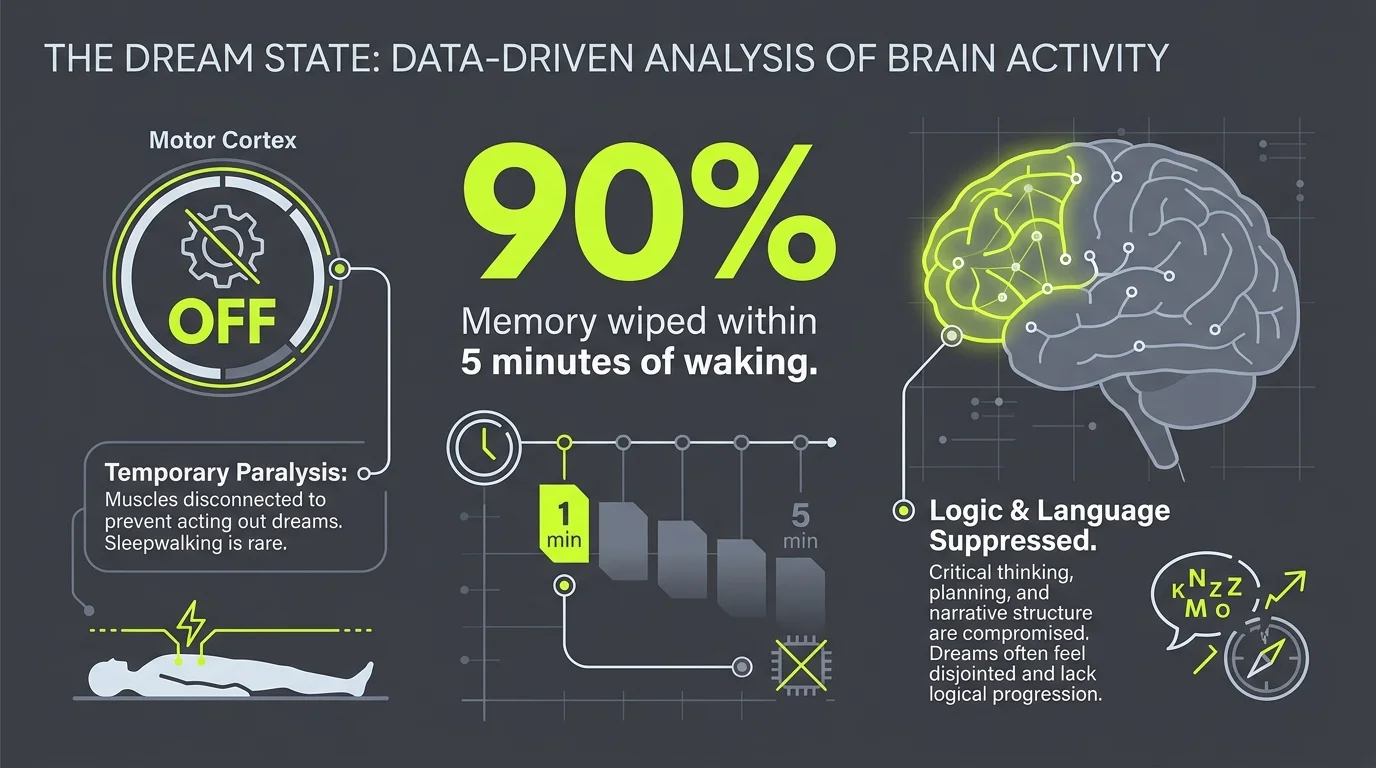
Your brain actively paralyzes your voluntary muscles during rapid eye movement sleep to prevent you from acting out your nightly visions. Researchers understand the biological mechanism behind this temporary paralysis, but they still actively debate why the evolutionary timeline favored this dangerous physical vulnerability over simply turning off the motor cortex.
You cannot read text, accurately tell time, or operate complex machinery in the vast majority of your dreams. The neurological pathways responsible for high-level language processing and strict logic undergo severe suppression during sleep, effectively preventing your mind from rendering coherent letters or maintaining stable numbers.
Blind individuals experience incredibly rich, highly sensory dreams that do not rely on visual imagery. Their sleeping minds automatically construct intense auditory, tactile, and olfactory environments that fully immerse them in the dream state, proving that visual data is not biologically necessary for complex, emotionally resonant dreaming.
Your brain aggressively purges dream content within five minutes of waking up, permanently erasing up to ninety percent of the narrative. Evolutionary biologists hypothesize this rapid forgetting prevents you from confusing waking reality with sleep simulations, though the exact chemical trigger responsible for this massive memory wipe remains unidentified.
Many people frequently experience hypnic jerks—the sudden, terrifying sensation of falling just as they drift into sleep. Neurologists suspect your nervous system misinterprets natural muscle relaxation as a dangerous physical fall, prompting a massive, immediate surge of adrenaline to wake you up and save your life.
You only dream about faces you have already encountered in your waking life. Your sleeping brain lacks the sheer processing power to invent brand-new human faces from scratch, relying entirely on a massive subconscious database of strangers, background actors, and daily acquaintances you have seen over the years.
Lucid dreaming occurs when your prefrontal cortex suddenly awakens while the rest of your brain remains deeply entrenched in REM sleep. This rare neurological hybrid state allows you to consciously control the dream narrative, but cognitive scientists cannot entirely explain exactly what internal mechanism triggers this spontaneous localized awakening.
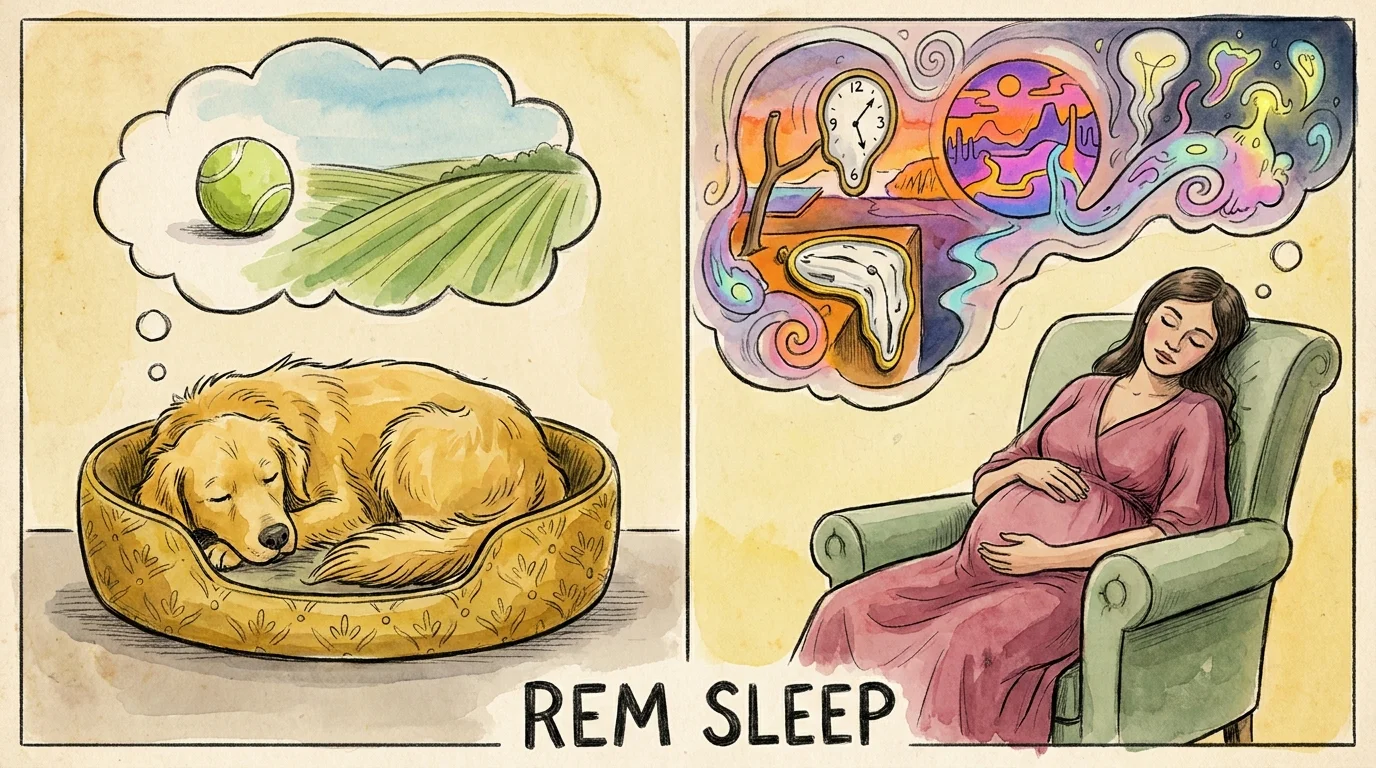
Most mammals and birds exhibit distinct REM sleep cycles, strongly suggesting they also experience vivid dreams. However, verifying the actual narrative content of a dog or cat’s dream requires advanced brain-computer interface technology that currently does not exist within the field of modern dream science.
Pregnancy dramatically alters overall dream intensity and emotional resonance in expectant mothers. Hormone fluctuations undoubtedly play a major role, but researchers cannot entirely explain why pregnant individuals consistently report uniquely bizarre, highly stressful, and hyper-vivid nightmares at a much higher rate compared to the general adult population.
Context and Background
The discovery of REM sleep in 1953 by Eugene Aserinsky and Nathaniel Kleitman revolutionized modern brain science. Before this massive breakthrough, scientists widely assumed the sleeping brain simply powered down to rest and conserve energy. By attaching early electroencephalogram electrodes to sleeping subjects, researchers noticed periods of intense, rhythmic brain activity coupled with rapid, erratic eye movements. Your brain during REM sleep burns glucose and fires neurons just as rapidly as when you are awake and actively solving complex mathematical equations. Despite successfully mapping this localized activity, identifying the core biological objective behind this intense, nightly energy expenditure remains a profound scientific mystery.
The activation-synthesis model, proposed by prominent sleep researchers J. Allan Hobson and Robert McCarley, offers one of the most accepted biological explanations for dreaming. Your brainstem consistently fires chaotic, entirely random electrical impulses during REM sleep. Your forebrain—the logical, narrative-building center of your mind—desperately tries to stitch these random neurological signals into a cohesive, linear story. This biological panic explains why your dreams so often feature bizarre transitions, disjointed physical locations, and highly illogical plot twists. Your conscious mind acts as a panicked film director forced to make a cohesive movie out of totally unrelated film reels, doing its absolute best to impose order on biological static.
While you sleep, your brain performs critical cognitive maintenance through a process known as memory consolidation. It transfers short-term factual and episodic memories from the fragile hippocampus directly to the neocortex for secure, long-term storage. Dreaming might simply serve as the accidental conscious byproduct of this massive, automated data transfer. When you dream about disconnected fragments of your daily life, you are literally watching your brain organize its internal filing cabinets. You can leverage this biological function practically; studying complex material or physically practicing a new mechanical skill right before you sleep significantly improves your retention rates and overall morning performance.
Evolutionary psychologists heavily champion the threat simulation theory to explain the overwhelming prevalence of negative dream states. Your ancient human ancestors constantly needed a perfectly safe environment to practice avoiding lethal predators, fighting territorial enemies, and navigating complex social disasters. Your brain evolved the dream state as an advanced, highly immersive virtual reality simulator. By exposing you to simulated danger while you lie safely paralyzed in your bed, your nervous system continuously rehearses its vital fight-or-flight responses. This evolutionary framework elegantly explains why common anxiety dreams—like showing up to a final exam entirely unprepared or running endlessly from an unseen monster—are overwhelmingly more frequent than entirely joyful experiences.
Modern clinical researchers view REM sleep as a form of overnight emotional therapy, specifically designed to regulate your waking mood and emotional stability. During this specific sleep phase, your brain completely shuts off its supply of noradrenaline, a key anxiety-inducing stress chemical. You naturally re-process traumatic or highly stressful daily memories in a neurochemically calm, entirely safe environment, effectively stripping the painful emotional charge from the specific event. When you prioritize getting a full night of uninterrupted sleep after a deeply distressing day, you give your brain the necessary physiological time to defang your acute anxieties, allowing you to wake up feeling emotionally resilient and thoroughly equipped to handle reality.
Recent functional neuroimaging highlights the crucial role of the default mode network during your nightly sleep cycle. This highly connected, sprawling web of brain regions exclusively governs your daydreams, spontaneous mind-wandering, and deep self-reflection while you are fully awake. When you slip into REM sleep, this network remains surprisingly active, collaborating heavily with your emotional centers to construct your unique dream identity. However, because your executive control network—the specific area responsible for strict logic and physical impulse control—shuts down, your default mode network operates without any rational supervision. This unguarded neurological play explains why you completely accept the absurd logic of your dreams as undeniable, factual reality until the exact moment you open your eyes.
Despite these incredibly compelling biological theories, the severe limitation of current neuroimaging sustains the ultimate mystery of dream science. Functional magnetic resonance imaging and advanced electroencephalograms successfully measure blood flow and electrical activity spikes, but they absolutely cannot show researchers the actual visual images playing out in your mind. This limitation represents the classic “hard problem” of human consciousness; scientists can easily track the physiological mechanics of your sleep, but the subjective, fully internal experience of dreaming remains entirely locked inside your skull.
Interesting Connections
The hypnagogic state—the bizarre, transitional threshold between bright wakefulness and deep sleep—holds incredible, untapped potential for creative problem-solving. Historical innovators famously exploited this brief neurological window to force breakthroughs. Famous inventors would tightly hold heavy metal balls in their hands while purposely drifting to sleep in a comfortable chair. The exact moment their muscles completely relaxed into sleep, the metal balls would crash loudly to the floor, instantly waking them up. They would immediately write down the bizarre, highly creative associations their unfiltered minds had just formed. You can harness this exact creative mechanism by keeping a dedicated notepad on your nightstand and recording your racing thoughts the exact second you wake up, capturing fleeting ideas before the strict logical constraints of your prefrontal cortex fully engage.
Some of the most profound scientific and artistic breakthroughs in human history originated entirely within the confines of the dream state. The famous chemist Dmitri Mendeleev struggled endlessly for months to organize the known chemical elements until the entire periodic table vividly appeared to him in a dream, perfectly arranged by precise atomic weight. Musician Paul McCartney woke up one morning with the fully formed, iconic melody for the hit song “Yesterday” looping seamlessly in his head, initially terrified he had accidentally plagiarized someone else’s historical work. When your sleeping brain successfully bypasses your waking logical filters, it easily connects highly disparate concepts and forms innovative, complex patterns that your conscious, awake mind would instantly reject as entirely absurd.
Your sleeping brain maintains a surprisingly active, vigilant connection to your immediate physical environment, constantly monitoring external stimuli and creatively weaving them directly into your ongoing dream narrative. If a hallway smoke detector steadily beeps or a distant police siren wails, your brain might rapidly generate a dream about a school fire alarm or a hospital ambulance rather than forcefully waking you up. The human olfactory system possesses a direct, powerful neural pathway straight to your deepest emotional centers. Clinical research strongly indicates that deliberately pumping the scent of roses or lavender into a bedroom reliably induces highly positive, peaceful dreams, while sulfur or rotten eggs consistently trigger intense, negative nightmares. You can apply this insight to your nightly routine by strategically using essential oil diffusers to actively shape the underlying emotional tone of your sleep.
Your overall mental health deeply dictates your personal dream architecture and exact REM sleep density. Individuals currently suffering from severe clinical depression consistently experience much earlier onsets of REM sleep and significantly longer, far more emotionally intense dream periods. Conversely, those battling chronic Post-Traumatic Stress Disorder suffer a massive breakdown in the baseline emotional regulation mechanism of dreaming. Instead of processing raw memories in a perfectly calm state, their brains experience severe, damaging spikes in noradrenaline during REM sleep, tragically transforming normal emotional processing into terrifying, hyper-vivid night terrors. Organizations like the American Psychological Association note that seeking professional cognitive behavioral therapy can permanently rewire these damaging sleep associations and completely restore the restorative function of your nightly cycle.
The growing, highly active community of lucid dreamers actively experiments with specialized dietary supplements to intentionally hack their sleep architecture. Galantamine, a powerful medication traditionally utilized to treat early Alzheimer’s disease, significantly increases the baseline concentration of acetylcholine throughout the brain. When taken precisely in the middle of the night, this specific compound strongly forces the logical prefrontal cortex to awaken while the physical body remains entirely paralyzed in REM sleep, drastically increasing the odds of inducing a fully conscious dream state. While this boldly demonstrates how heavily dream chemistry relies on precise neurotransmitter balances, organizations like the Sleep Foundation warn strictly against using any synthetic compounds to alter your natural sleep cycle without direct medical supervision.
Modern digital technology fundamentally alters the visual and spatial landscape of your subconscious mind. Behavioral psychologists explicitly refer to the “Tetris effect,” a well-documented phenomenon where people who actively play visually repetitive video games for hours directly see the game’s geometric shapes falling in their mind’s eye as they heavily drift off to sleep. Intensive, daily gamers actually report feeling significantly less threatened or afraid during nightmares because their highly trained brains automatically treat the frightening dreamscape exactly like a familiar virtual environment they can control, violently manipulate, or quickly conquer. If you personally suffer from frequent, paralyzing night terrors, routinely engaging in empowering, spatial-awareness video games during the day might successfully provide your subconscious with the cognitive tools to confidently fight back against your nighttime demons.
Frequently Asked Questions
Why do I keep having recurring nightmares?
Recurring nightmares directly signal an unresolved psychological conflict, chronic waking stress, or deeply unhealed trauma. Your brain physically gets stuck in a frustrating neurological loop, repeatedly attempting to process a specific, intense negative emotion but ultimately failing to reach a permanent resolution. Until you actively address the waking stressor, your subconscious will stubbornly continue to run the exact same terrifying simulation night after night. You can actively combat this agonizing phenomenon using imagery rehearsal therapy. During the day, explicitly write out the exact narrative of your recurring nightmare on paper, but consciously change the ultimate ending to something highly positive, safe, and empowering. Diligently reviewing this new script immediately before bed effectively trains your brain to adopt the safer narrative and permanently break the nightmare loop.
Can my diet affect the vividness of my dreams?
Your daily dietary choices directly and heavily influence the complex neurochemical environment of your sleeping brain. Actively consuming foods naturally high in vitamin B6—like bananas, chickpeas, and wild-caught salmon—dramatically enhances your brain’s biological ability to quickly convert tryptophan into serotonin, leading to incredibly vivid, highly memorable dreams. Conversely, eating heavy, dense, carbohydrate-rich meals immediately before bed massively spikes your resting metabolism and rapidly raises your core body temperature. This unnecessary physiological spike artificially increases baseline brain activity and frequently triggers bizarre, highly stressful dreams that disrupt deep rest. If you strongly desire a calm, restorative night of sleep, make absolutely sure to finish your final heavy meal at least three solid hours before pulling back the covers.
Is it possible to share a dream with another person?
Despite countless anecdotal, unverified claims and pervasive internet rumors, modern neuroscientists firmly and entirely reject the concept of telepathic or truly shared dreaming. When you and a romantic partner unexpectedly experience a highly similar dream on the exact same night, you are simply experiencing the natural biological results of shared environmental stimuli and identical mutual daily experiences. If you both intently watched the same stressful evening news report, ate the exact same dinner, and slept in the very same temperature-controlled room, your brains naturally generated remarkably similar nighttime simulations based on entirely identical data inputs. There is absolutely no known biological mechanism that allows two isolated human brains to magically broadcast internal imagery to one another.
Do men and women dream differently?
Extensive sociological and psychological studies consistently reveal distinct, measurable demographic patterns in overall dream content, which are heavily influenced by daily waking life preoccupations. Men consistently report having dreams heavily featuring direct physical aggression, vast outdoor settings, and a significantly higher ratio of unknown male characters. Women generally report having dreams involving complex, nuanced verbal interactions, familiar indoor environments, and an almost perfectly equal split of male and female characters. These observed differences absolutely do not stem from rigid, unavoidable biological destiny. Rather, they closely reflect the specific societal roles, daily emotional stressors, and profound social conditioning individuals must carefully navigate during their waking hours. As societal gender roles continue to rapidly shift and broadly evolve, modern sleep researchers note that these historical dream content disparities are already slowly shrinking.
Why do I talk or walk in my sleep if my muscles are paralyzed?
Sleepwalking and aggressive sleeptalking rarely actually occur during REM sleep, the specific phase where your hyper-vivid dreams and active muscle paralysis securely take place. Instead, these strange, highly active physical behaviors—clinically known by medical professionals as parasomnias—manifest almost entirely during your deep, non-REM sleep phases. In this specific sleep phase, your muscles remain perfectly capable of uninhibited movement, but your conscious mind is entirely shut down and resting. Parasomnias unexpectedly happen when your brain awkwardly attempts to transition between deep sleep and lighter sleep but tragically gets caught in a bizarre, unmapped hybrid state. Your motor cortex wakes up just enough to allow you to walk, eat, or loudly speak, but your rational prefrontal cortex remains deeply asleep, permanently leaving you with absolutely no memory of your confusing nocturnal adventures.
