In this article 4 sections
A featherweight bird weighing less than a nickel recently flew an astonishing 4,055 miles across North America in just 38 days. This male rufous hummingbird journeyed from coastal Alabama to Juneau, Alaska, completely transforming our scientific understanding of animal endurance.
Revolutionary solar transmitters tracked every stage of this flight, logging over 6,500 cumulative kilometers without impeding the tiny traveler. You can now witness the biological mechanics and flight pathways that empower such small creatures to conquer vast continents.
These discoveries reveal unexpected flight detours and provide critical wildlife facts to help protect rapidly declining migratory populations.
Fast Facts
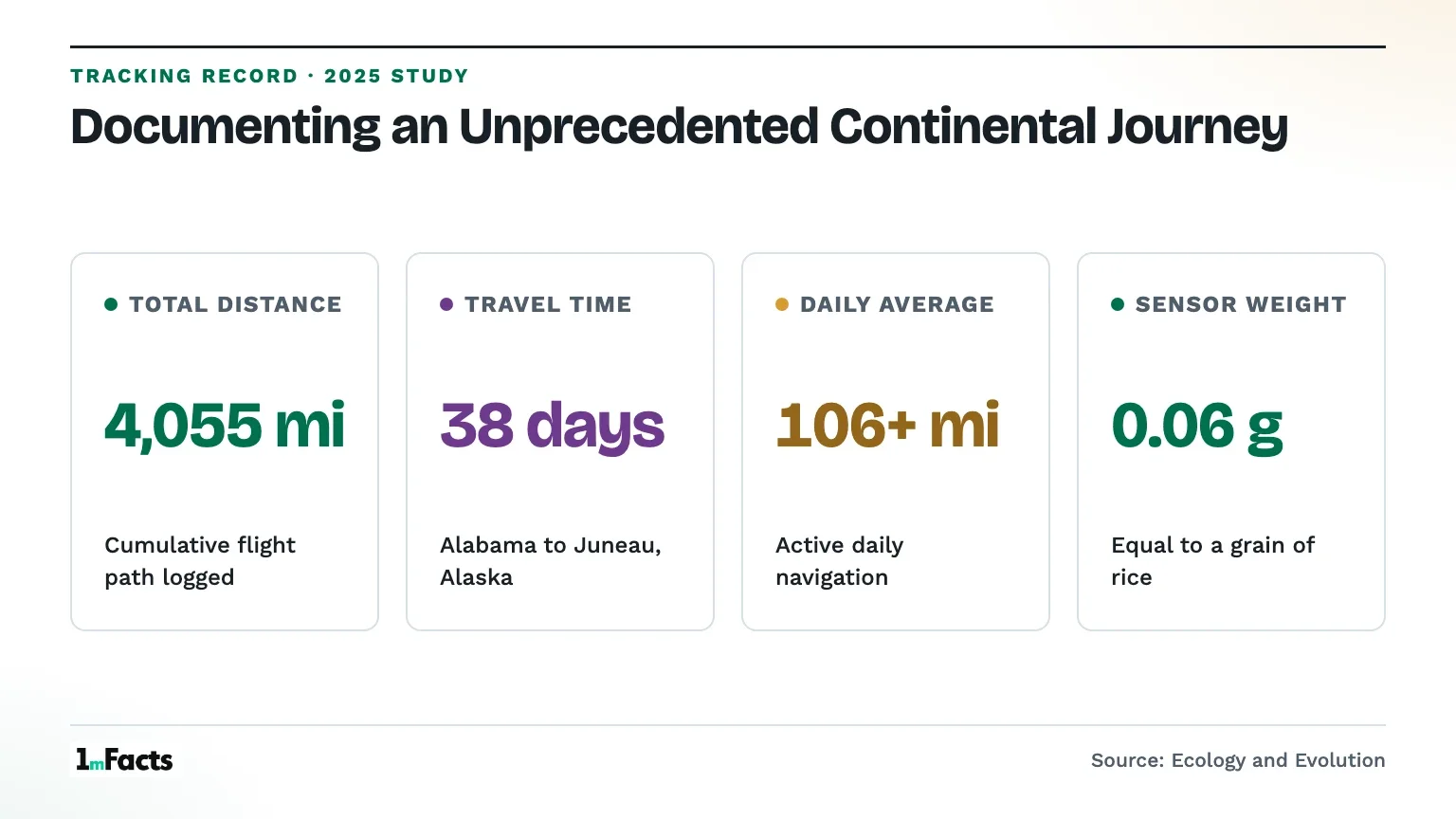
An adult male rufous hummingbird flew 4,055 cumulative miles across North America in only 38 days. This record-breaking trek represents the longest cumulative hummingbird migration ever documented by active tracking equipment.
The bird traveled an average of more than 106 miles each day between Alabama and Alaska. Its straight-line distance measured 2,939 miles, but natural navigation loops significantly expanded the true flight path.
Researchers captured this data using solar-powered BlūMorpho transmitters weighing just 0.06 grams. That tiny mass equals roughly the weight of a single grain of rice.
The miniature transmitter broadcasts a 2.4 GHz Bluetooth signal every three seconds whenever sunlight strikes its panel. Nearby smartphones, computers, and automated receiver stations detect these transmissions from up to 200 meters away.
Older radio tags from 2018 weighed nearly five times more and died within ten days. These modern solar devices keep transmitting indefinitely, with some units logging bird tracking data for 128 days.
Before departing on migratory journeys, hummingbirds double their body weight by consuming copious amounts of nectar and tiny insects. Their metabolic engines burn through these fat deposits while their hearts beat over 1,200 times per minute.
The research initiative collected 23,784 individual location records across 23 states, Canada, and Mexico. These findings revealed that individual birds rarely fly in rigid, uniform straight lines.
One tracked rufous hummingbird completed a 214-mile loop through Tennessee and Missouri before resuming its journey eastward. These wandering routes prove that local weather and flower blooms constantly reshape flight choices.
Rufous hummingbirds have experienced a 72 percent population decline since 1968, losing roughly 2.2 percent annually. Pinpointing their exact stopover habitats gives conservationists actionable targets to safeguard vulnerable refueling corridors.
North American federal regulations require research transmitters to weigh less than three percent of a hummingbird’s total body mass. This legal threshold ensures that auxiliary tracking tags do not compromise normal flight mechanics or survival.
Context and Background
For decades, ornithologists faced a technological barrier when studying hummingbird migration. Because these birds weigh between two and five grams, traditional satellite transmitters were simply too heavy for them to carry safely.
In November 2026, physiologist Emma M. Rhodes and her research team published a landmark study in the journal Ecology and Evolution. Their breakthrough documented the movement of 11 hummingbirds equipped with ultralight solar devices.
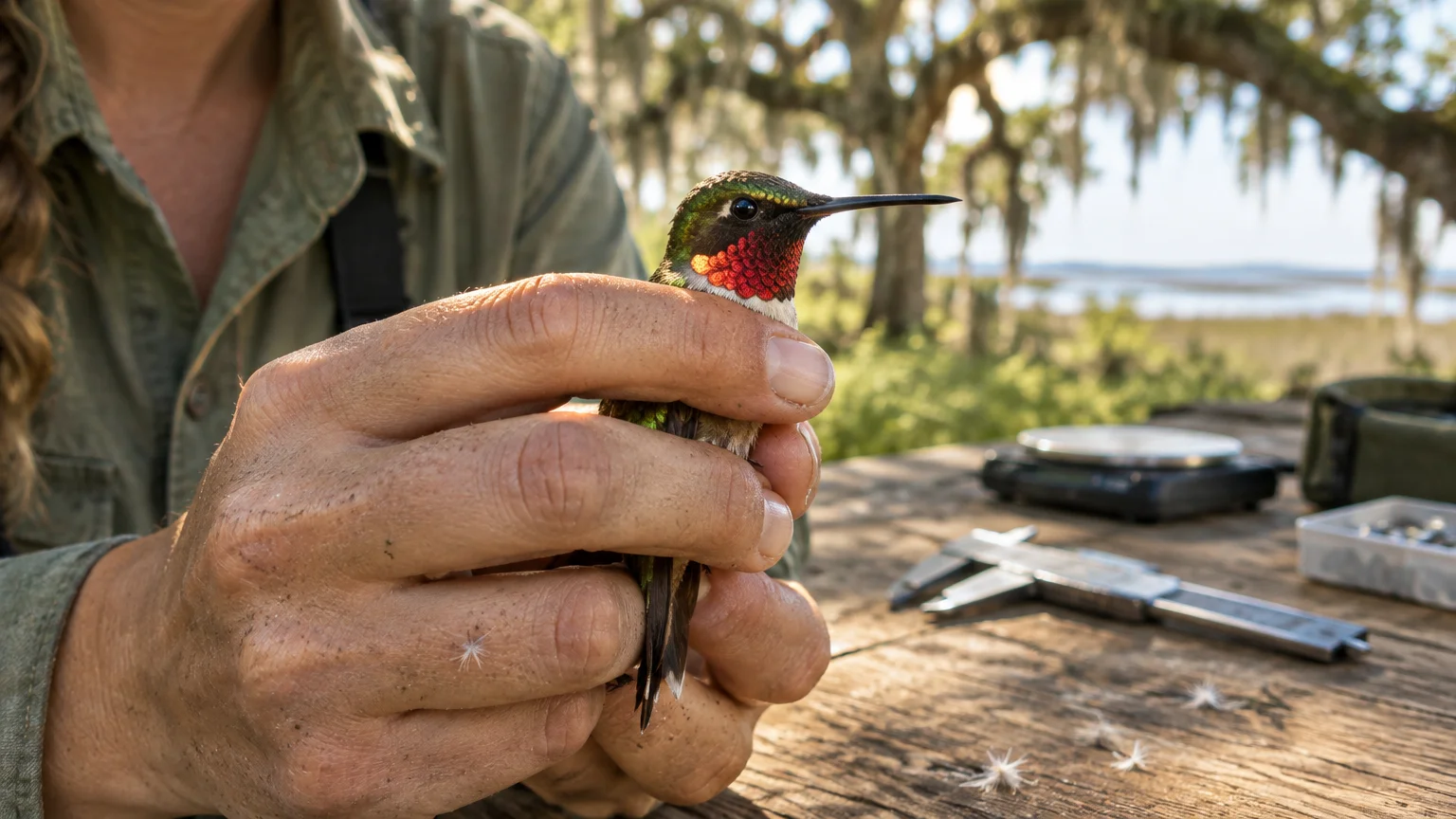
Scientists applied the tiny tags between the shoulder blades of four rufous and seven ruby-throated hummingbirds in Alabama and Florida. The devices adhered securely without injuring skin or restricting wing movement.
The star of the project—an adult male rufous hummingbird—departed Lillian, Alabama, on March 27, 2025. It traveled across northern Mexico, swept northward along the Pacific coastline, and reached Juneau, Alaska, on May 3, 2025.
Its journey shattered prior expectations of travel speed and endurance. Ground receivers recorded 1,015 individual detections for this single bird as it conquered mountains, deserts, and coastal headwinds.
Prior to this active tracking breakthrough, scientists relied on metal leg bands to measure migration distances. In 2010, researchers banded a female rufous hummingbird in Florida that was recaptured 166 days later in Alaska.
While that 2010 recovery proved birds could cross the continent, it left travel speed and exact routes completely dark. The new solar sensors illuminate daily flight rhythms and reveal precisely where birds rest and refuel.

Interesting Connections
Hummingbirds possess the highest mass-specific metabolic rate of any vertebrate animal. To survive continuous flight across barren terrain, they utilize specialized physiological tricks that push animal endurance to extreme biological limits.
When food grows scarce or temperatures plummet at night, hummingbirds drop into torpor. This state of temporary hibernation lowers their body temperature and slows their heart rate from hundreds of beats per minute to near standstill.
By conserving precious calories overnight, hummingbirds preserve the fat reserves required for intense daytime flying. You can witness this high-octane engine in your own backyard whenever a migrant visits your nectar feeder.
The 2026 study also revealed fascinating social dynamics and route diversity among ruby-throated hummingbirds. Two tagged males migrated northward along nearly identical parallel paths roughly 83 kilometers apart over two days.
Meanwhile, a female ruby-throated hummingbird surprised researchers by flying southeast into peninsular Florida instead of heading north. These individual choices demonstrate that avian navigation relies on dynamic environmental cues rather than rigid instincts.
Furthermore, the BlūMorpho tracking technology integrates with the global Motus Wildlife Tracking System and ordinary handheld electronics. Any compatible smartphone or tablet within 200 meters can act as a passive receiver, quietly contributing to migratory science.
Connecting data across borders is essential because rufous hummingbirds face severe ecological risks. The IUCN Red List categorizes the species as Near Threatened following decades of intense habitat degradation.
Breeding bird surveys show that rufous hummingbirds dropped by roughly 43 percent between 2006 and 2021 alone. Documenting their essential resting corridors helps conservation planners protect critical nectar corridors along international routes.
Frequently Asked Questions
How can a hummingbird fly 4,000 miles without starving?
Hummingbirds prepare for migration by entering hyperphagia, feeding constantly to double their body weight in fat. They burn this concentrated fuel during flight and replenish energy stores by stopping at flower-rich rest sites along their path.
How do solar Bluetooth trackers stay on such small birds?
Researchers use specialized, non-toxic adhesives to glue the 0.06-gram transmitter directly between the bird’s shoulder blades. The device naturally sheds during the hummingbird’s annual molt, leaving the plumage undamaged.
What regulations govern hummingbird bird tracking research?
Federal law strictly protects wild hummingbirds under the Migratory Bird Treaty Act and federal banding regulations. Scientists must obtain specialized authorizations from the USGS Bird Banding Laboratory and state wildlife agencies before handling wild birds.
Why do hummingbirds take winding detours instead of flying straight?
Hummingbirds frequently alter their paths to avoid severe mountain storms, crosswinds, and food deserts. Following winding valleys and river corridors ensures they encounter continuous nectar blooms to sustain their metabolic demands.
How can you help migrating hummingbirds in your area?
You can maintain backyard feeders filled with fresh sugar water made of four parts water to one part refined white sugar. Planting native tubular flowers provides essential natural nectar and supports the tiny insects hummingbirds need for protein.