


The world constantly hides incredible realities right in front of your eyes. While you navigate your daily routine, nature, history, and science quietly operate under rules that often defy human logic. Building a strong foundation of trivia knowledge does much more than help you win at a local pub quiz; it profoundly shifts how you perceive your environment. When you expose yourself to surprising info, you train your brain to actively question assumptions and look closer at the mundane details of life. Educational fun naturally leads to a highly curious mindset, keeping you mentally agile and open to continuous learning.
In this exploration, you will discover twenty fascinating truths that challenge everything you thought you understood. Grasping these interesting facts allows you to appreciate the sheer complexity of our universe. Whether you use these insights to spark engaging conversations or to simply marvel at the mechanics of biology and physics, understanding these random facts gives you a much broader, more dynamic perspective on your everyday existence.
Fast Facts
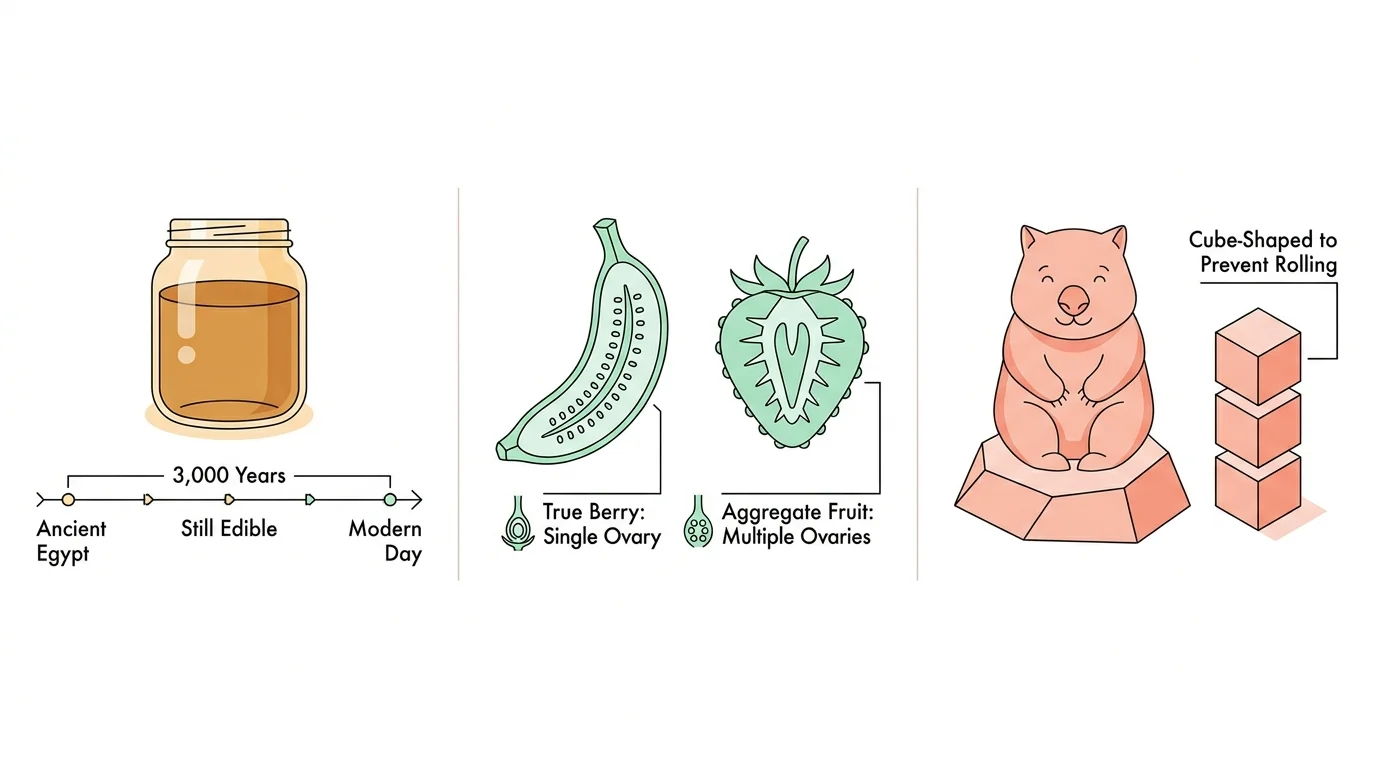
1. Honey remains edible practically forever. You can safely eat honey that has been sitting in a sealed jar for centuries. Archaeologists excavating ancient Egyptian tombs frequently discover pots of honey dating back over three thousand years, and it remains perfectly safe for human consumption. This incredible longevity happens because honey naturally possesses an acidic pH and extremely low moisture content. These two factors create a highly osmotic and hostile environment where bacteria simply cannot survive. If your honey crystallizes in the pantry, do not throw it away; place the glass jar in a bowl of warm water to gently dissolve the sugar crystals, reducing household food waste.
2. Bananas naturally classify as berries, but strawberries completely miss the mark. When you evaluate the fruits in your kitchen through a strict botanical lens, the definitions become counterintuitive. A true berry develops from a single flower containing one ovary and typically features distinct fleshy layers containing seeds. Because bananas fit this precise anatomical requirement, scientists classify them as true berries. Conversely, strawberries develop from a flower with multiple distinct ovaries, making them aggregate fruits. Understanding these biological classifications helps you make smarter choices when planting a garden, allowing you to appreciate the complex evolutionary traits of the foods you consume.
3. Wombats produce cube-shaped droppings to efficiently mark their territory. Nature often engineers bizarre solutions to practical problems, and the Australian wombat serves as a prime example. These marsupials excrete distinctive, dice-like feces, which remains a highly unusual trait in the animal kingdom. Wombats have poor eyesight but excellent senses of smell, so they stack their droppings on elevated surfaces like rocks to communicate. The cubic shape entirely prevents the feces from rolling off these steep surfaces. Observing how biology solves structural problems often inspires practical packaging and architectural innovations for human use.
4. Scotland adopted the mythical unicorn as its official national animal. While most countries choose majestic eagles or fierce lions to represent their heritage, Scotland opted for a creature of pure fantasy. During the late fourteenth century, Scottish royalty incorporated the unicorn into their heraldry. In Celtic mythology, people revered the unicorn for its fierce independence, purity, and untamable nature. The Scottish believed the unicorn was the natural enemy of the lion, which conveniently served as the symbol of their historical rival, England. You can use this knowledge to better interpret the subtle branding and symbolic messaging used by modern nations.
5. The Eiffel Tower physically grows taller during the hot summer months. If you plan to visit Paris, your experience of the city’s most famous landmark physically changes depending on the season. The Eiffel Tower is constructed entirely from iron, a metal highly susceptible to thermal expansion. When the intense summer sun heats the iron structure, the kinetic energy of the metal atoms increases, causing them to take up more physical space. This reaction makes the entire tower expand up to fifteen centimeters taller. Grasping the principles of thermal expansion allows you to better understand the necessary engineering joints built into modern bridges.
6. The shortest commercial flight in the world takes under one minute. While you might associate air travel with long hours in cramped cabins, a regional airline in Scotland offers a drastically different experience. The flight operating between the islands of Westray and Papa Westray covers a microscopic distance of just 1.7 miles. Under ideal wind conditions, the entire journey from takeoff to touchdown lasts a mere fifty-seven seconds. The service acts as a crucial lifeline for the tiny island populations, transporting teachers and vital medical supplies. Learning about these hyper-local transportation networks broadens your understanding of how aviation adapts to unique geographical challenges.
7. Peanuts do not belong to the nut family; they are ground-dwelling legumes. Despite having the word ‘nut’ right in their name, peanuts share more biological traits with lentils, soybeans, and peas than they do with walnuts or pecans. True botanical nuts grow on trees and feature a hard outer shell that does not naturally split open to release the seed. Peanuts develop entirely underground in a pod that easily splits apart. After the peanut plant flowers above ground, the stem dramatically bends downward and buries itself in the soil to mature. Knowing this agricultural distinction actively helps you navigate dietary restrictions and food allergies more effectively.
8. Sloths can easily outlast dolphins in an underwater breath-holding contest. You probably view dolphins as the undisputed champions of aquatic respiration, but the notoriously sluggish sloth actually holds a biological advantage. A dolphin typically surfaces for air every eight to ten minutes. In stark contrast, a sloth can intentionally slow its heart rate down to a mere third of its normal pace, allowing the animal to hold its breath underwater for an astonishing forty minutes. Sloths utilize this remarkable survival mechanism to safely cross rivers in their native rainforest habitats. Recognizing how different species optimize their energy expenditure provides you with a powerful metaphor for endurance and pacing.
9. A single pineapple requires over two years of careful cultivation to reach maturity. When you quickly toss a fresh pineapple into your grocery cart, you likely overlook the massive investment of time required to produce it. Pineapples belong to the bromeliad family and do not grow on trees; instead, they sprout from a leafy plant low to the ground. The plant must undergo months of vegetative growth before it even produces a single flower. Once the flower blooms, it takes many more months for the individual fruitlets to fuse together into the large, spiky fruit you recognize. Understanding this extreme patience required in farming makes you a more mindful consumer.
10. The Great Wall of China remains completely invisible from space to the naked eye. A pervasive urban legend claims that astronauts can easily spot this ancient fortification from low Earth orbit. However, individuals who have actually visited the International Space Station, as well as experts at NASA, have thoroughly debunked this myth. While the Great Wall stretches for thousands of miles, it is built from local stone and clay that perfectly blend into the surrounding natural landscape. Furthermore, the wall’s narrow width makes it impossible to resolve without the aid of high-powered telescopic lenses. Deconstructing popular myths encourages you to verify facts using reliable scientific sources.

Context and Background
11. Oxford University predates the founding of the Aztec Empire. You naturally tend to organize history into distinct, non-overlapping eras, often placing the medieval European universities in a modern box while pushing the Mesoamerican empires into an ancient, primitive past. However, Oxford University actively predates the founding of the Aztec Empire by several centuries. Teaching at Oxford began in various forms around the year 1096, making it the oldest university in the English-speaking world. Meanwhile, the indigenous Mexica people did not found their magnificent capital city of Tenochtitlan—which later became the heart of the Aztec Empire—until the year 1325. This means that scholars at Oxford had been debating philosophy and mathematics long before the first stones of the Aztec capital were laid. Recognizing this chronological overlap challenges your inherent biases about global development and helps you view historical timelines as parallel tracks.
12. Sharks patrolled the oceans millions of years before trees existed on land. When you walk through an ancient forest, you likely view the towering trees as the ultimate symbol of prehistoric life on Earth. Yet, the sharks swimming in the world’s oceans boast a biological lineage that heavily predates terrestrial wood. Paleontologists have discovered fossilized shark scales dating back roughly four hundred million years. In stark contrast, the earliest recognizable trees did not evolve and take root on land until around three hundred and fifty million years ago. Sharks survived four distinct mass extinction events, meaning their anatomical design proved spectacularly efficient. Grasping this immense timeline gives you a profound respect for marine ecosystems; when you advocate for ocean conservation, you actively protect one of the most successful biological blueprints this planet has ever engineered.
13. The nation of Russia boasts a larger surface area than the dwarf planet Pluto. If you look at a standard classroom map, the sheer scale of the global landmasses often becomes heavily distorted, leading you to misjudge the true size of nations. When you compare the surface area of Russia to Pluto, the earthly nation actually comes out on top. Russia spans a staggering seventeen million square kilometers, stretching across eleven different time zones. Meanwhile, the entire spherical surface area of Pluto measures approximately sixteen point six million square kilometers. You can apply this insight to your daily life by abandoning the flat Mercator projection maps that distort the northern hemisphere. Instead, rely on a physical globe or advanced digital mapping software to accurately comprehend international geopolitics and global distances.
14. The Earth contains vastly more trees than the Milky Way galaxy holds stars. You have undoubtedly gazed up at the night sky and felt entirely insignificant beneath the vast sea of stars. However, the earthly ground beneath your feet holds a numerical advantage over the cosmos. Astronomers estimate that the Milky Way galaxy contains anywhere from one hundred billion to four hundred billion stars. In a groundbreaking study utilizing satellite imagery, scientists determined that Earth currently supports over three trillion individual trees. The sheer volume of terrestrial plant life outnumbers the local stars by a factor of roughly ten to one. This revelation completely flips the script on how you measure biological abundance. By supporting local reforestation initiatives, you actively preserve a biological network that rivals the structural complexity of our home galaxy.
15. Woolly mammoths actively roamed the earth during the construction of the Great Pyramid. You likely place mammoths strictly in the Ice Age, alongside Neanderthals and saber-toothed tigers. However, a small population of mammoths survived on Wrangel Island off the coast of Russia until roughly four thousand years ago. This means that as Pharaoh Khufu commanded the massive construction of the Great Pyramid of Giza in ancient Egypt, ancient elephants covered in thick fur were still grazing in the arctic tundra. Understanding this fact forces you to dramatically restructure your mental timeline of history. You quickly realize that human architectural triumphs and prehistoric megafauna shared the exact same timeline, bridging the gap between primitive ecology and advanced human civilization.
Interesting Connections
16. A single day on the planet Venus lasts longer than its entire year. Consider the bizarre mechanics of planetary rotation by examining our neighboring planet, Venus. A single day on Venus—the time it takes for the planet to complete one full rotation on its axis—lasts for two hundred and forty-three Earth days. However, a single year on Venus—the time it takes for the planet to successfully orbit the sun—takes only two hundred and twenty-five Earth days. Because Venus rotates incredibly slowly and in a retrograde direction, a day technically outlasts a year. This astronomical quirk forces you to reevaluate how you experience the passage of time. Your entire circadian rhythm and daily schedule are entirely dictated by Earth’s specific rotational velocity, highlighting the delicate gravitational balance that makes human life possible.
17. You can detect a blue whale’s heartbeat from over two miles away. The physics of sound and the massive scale of marine biology collide spectacularly within the chest cavity of the blue whale. As the largest animal to ever exist on Earth, a blue whale requires a massive, highly efficient cardiovascular system. Its heart weighs roughly four hundred pounds, and the primary aorta remains large enough for a human child to comfortably crawl through. Because sound waves travel significantly faster and further through dense water than they do through thin air, acoustic researchers can detect a blue whale’s slow, thumping heartbeat from tremendous distances. This interesting fact directly highlights the urgent need to mitigate industrial noise pollution in the oceans, as artificial sounds easily disrupt the delicate sonic networks these magnificent creatures use to navigate.
18. Water emits drastically different sounds depending on its exact temperature. You interact with the principles of fluid dynamics every single morning without even realizing it. If you pay close attention, you will notice that cold water and hot water make distinctly different sounds when poured into a mug. As water heats up, its molecules gain kinetic energy and move further apart, which drastically lowers the liquid’s overall viscosity. Cold water remains thick and syrupy on a microscopic level, producing a lower, more muted acoustic frequency when it hits the bottom of a cup. Hot water splashes with a thinner, higher-pitched sound. By simply listening to the pitch of the pour, you can actively determine if your kettle has reached the perfect temperature for brewing coffee.
19. An average cumulus cloud easily weighs over one million pounds. When you look up at a fluffy, white cumulus cloud drifting lazily across the summer sky, you probably imagine a weightless wisp of cotton. In reality, you are looking at a colossal, floating reservoir of suspended water droplets. Meteorologists calculate that an average cumulus cloud contains so much liquid water that it easily tips the scales at over one million pounds. This massive weight stays aloft because the microscopic water droplets spread out over an incredibly vast area, allowing the warm updrafts of thermal energy to buoy the cloud upward. Understanding this specific intersection of atmospheric pressure and fluid dynamics completely transforms how you interpret local weather forecasts.
20. Your fundamental genetic code matches a banana by roughly fifty percent. You might feel completely disconnected from the plant life sitting on your kitchen counter, but your DNA tells a deeply interconnected story. At a fundamental cellular level, all living organisms share core biological functions. Both humans and bananas require specific genes that dictate how to divide cells, how to metabolize basic nutrients, and how to repair damaged DNA. Because all life on Earth evolved from a common ancestor billions of years ago, we retain a massive chunk of this essential genetic programming. Realizing that you share half of your biological blueprint with a piece of fruit radically changes your relationship with the natural world.
Frequently Asked Questions
Why do human brains enjoy learning random facts?
Your brain naturally craves novelty and unexpected stimulation. When you encounter surprising info that completely defies your existing expectations, your neurological system releases a small burst of dopamine. This chemical reward system originally evolved to help early humans quickly adapt to new environmental variables. Today, this exact same biological mechanism makes gathering trivia knowledge highly addictive, transforming learning into a deeply rewarding and engaging form of educational fun.
How can you effectively retain interesting facts in your permanent memory?
To lock trivia knowledge into your long-term memory, you must actively connect the new information to concepts you already understand. Rote memorization rarely works; instead, utilize a technique called spaced repetition. Review the new facts shortly after you learn them, and then gradually increase the intervals between review sessions. Furthermore, explaining the fact to a friend forces your brain to synthesize the information clearly, ensuring the data takes permanent root in your cognitive network.
Does absorbing trivia knowledge genuinely improve cognitive function?
Engaging heavily with educational fun actively builds and reinforces new neural pathways within your brain. When you continuously expose yourself to diverse subjects—ranging from astrophysics to ancient history—you promote neuroplasticity. This means your brain remains highly flexible and resilient as you age. Consistently learning interesting facts serves as a practical mental workout, enhancing your analytical thinking skills, improving your general recall, and allowing you to draw highly creative connections between completely unrelated disciplines.
