

Exploring the universe exposes realities that challenge your fundamental understanding of physics and nature. You will discover atmospheric phenomena, immense cosmic scales, and celestial anomalies that sound like absolute science fiction but represent thoroughly documented astronomical science facts. From planets that completely defy standard orbital logic to bizarre sensory experiences reported by returning astronauts, these mind-bending cosmic truths fundamentally shift your perspective on how the universe operates. Comprehending these extreme conditions equips you with a highly accurate picture of the surrounding galaxy. By systematically examining the rigorous data collected by modern space probes and advanced telescopes, you can easily separate popular myths from genuine universe discoveries and deeply appreciate the actual, unbelievable mechanisms governing the vast cosmos.

Fast Facts
Space constitutes an almost perfect vacuum, meaning it contains absolutely no air or physical medium required to transmit acoustic waves. If you were to detonate an explosive device directly outside your spacecraft, you would observe a completely silent flash of light because the physical vibrations possess no atmospheric particles to travel through.
Venus maintains a completely inhospitable surface temperature that regularly exceeds 880 degrees Fahrenheit, rendering it significantly hotter than Mercury despite sitting much further from the Sun. A dense, runaway greenhouse effect driven by a thick carbon dioxide atmosphere continuously traps intense solar radiation beneath impenetrable clouds of highly corrosive sulfuric acid.
When engineers originally designed and built the iconic NASA spacesuits in 1974, each unit cost the space agency approximately $12 million; adjusting that specific figure for modern inflation brings the current value to over $150 million. These exceptional garments operate less like standard clothing and much more like completely self-sufficient, miniature human-shaped spacecraft equipped with highly advanced oxygen circulation, active temperature regulation, and vital telemetry systems.
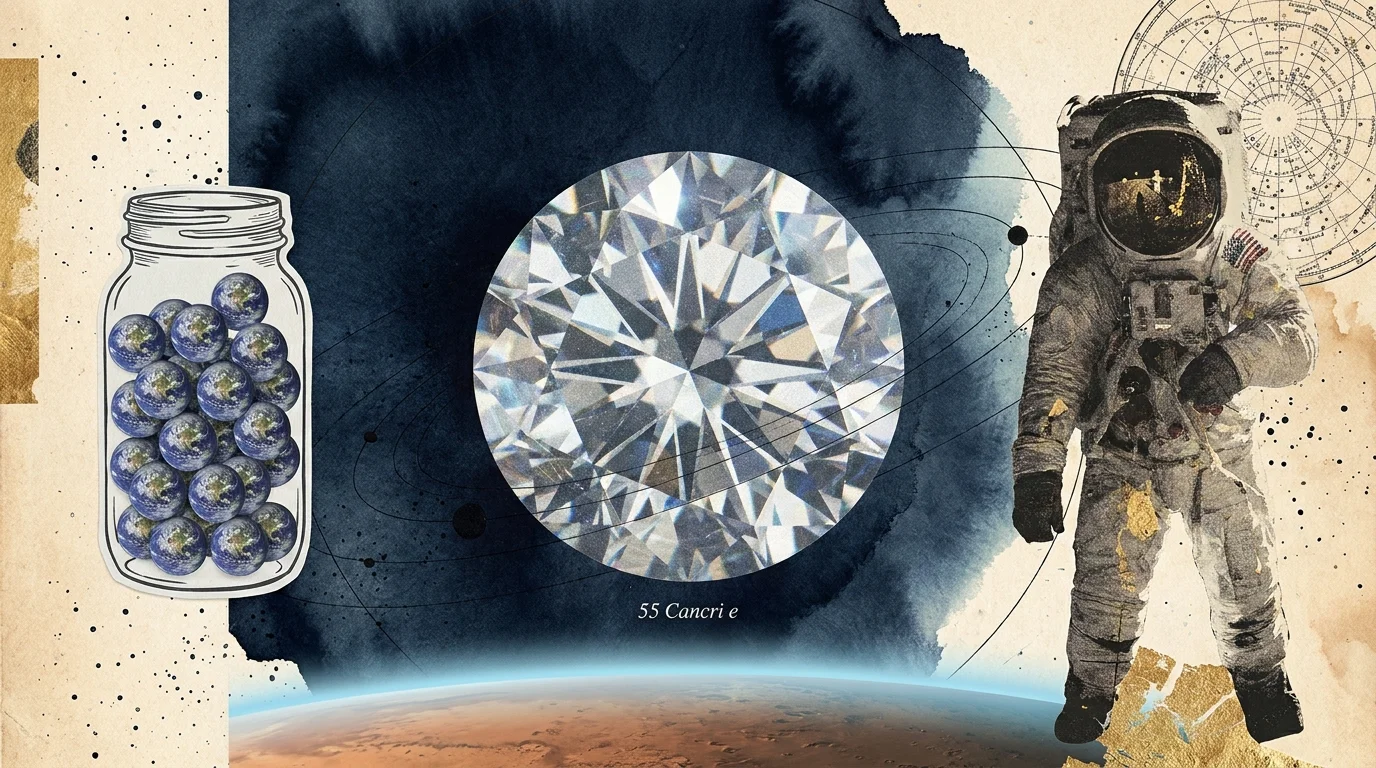
You could fit approximately one million Earth-sized spheres directly inside the Sun if you hollowed out the massive star and filled it up like a gigantic glass jar. This gargantuan nuclear fusion reactor single-handedly accounts for 99.8 percent of the total mass within our entire solar system, perfectly illustrating the profound physical scale differential between main-sequence stars and standard terrestrial planets.
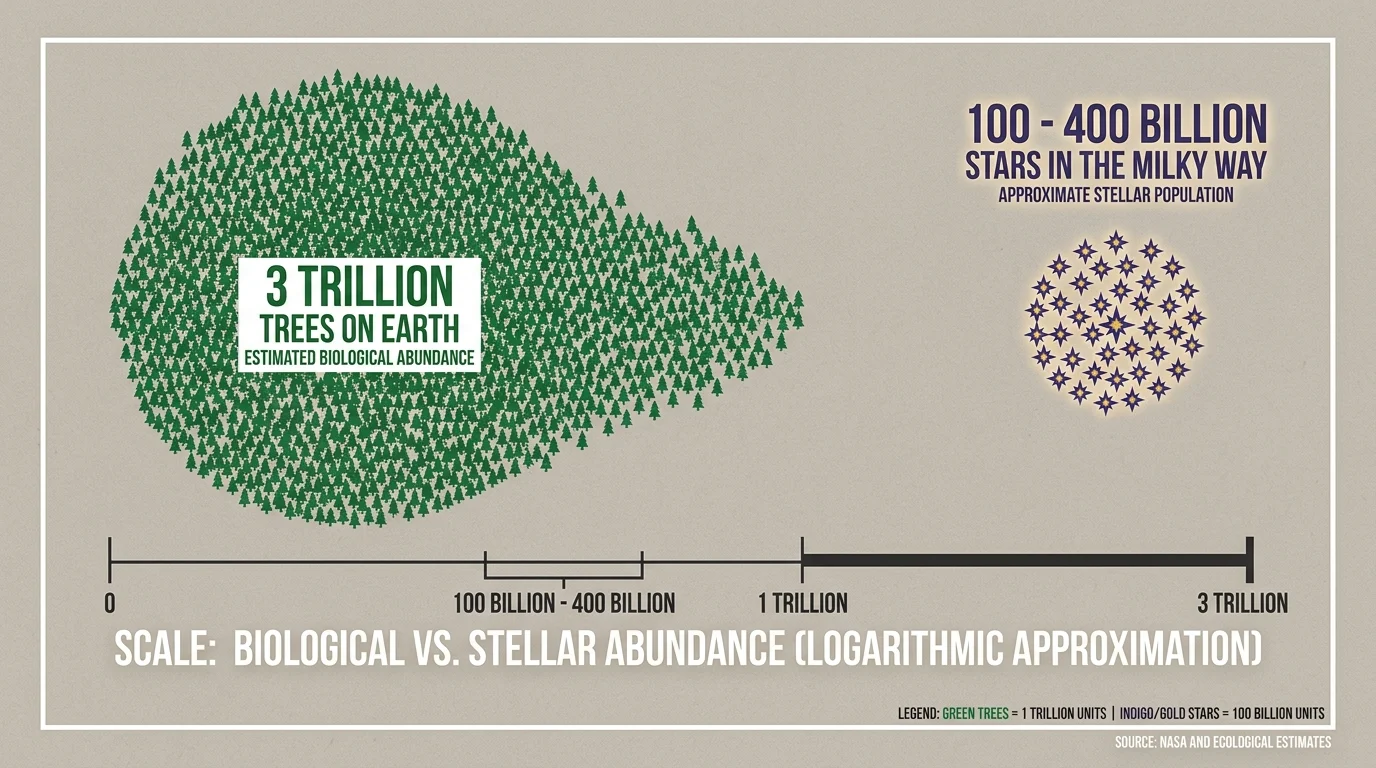
Earth currently supports an estimated three trillion individual trees across its various global biomes, a staggering ecological figure that comfortably eclipses the estimated 100 to 400 billion stars scattered throughout the Milky Way galaxy. You might naturally assume that a sprawling cosmic structure contains infinitely larger numbers than a single rocky planet, but the overwhelming density of biological abundance on our home world definitively overtakes stellar populations.
When you watch the sunset from the desolate surface of Mars, the sky projects a striking, distinct blue glow across the surrounding rocky landscape instead of the familiar red and orange hues seen on Earth. Extremely fine iron oxide dust particles constantly suspended in the thin Martian atmosphere permit blue light to penetrate the air much more efficiently, actively scattering the warmer red light away from your direct field of vision.
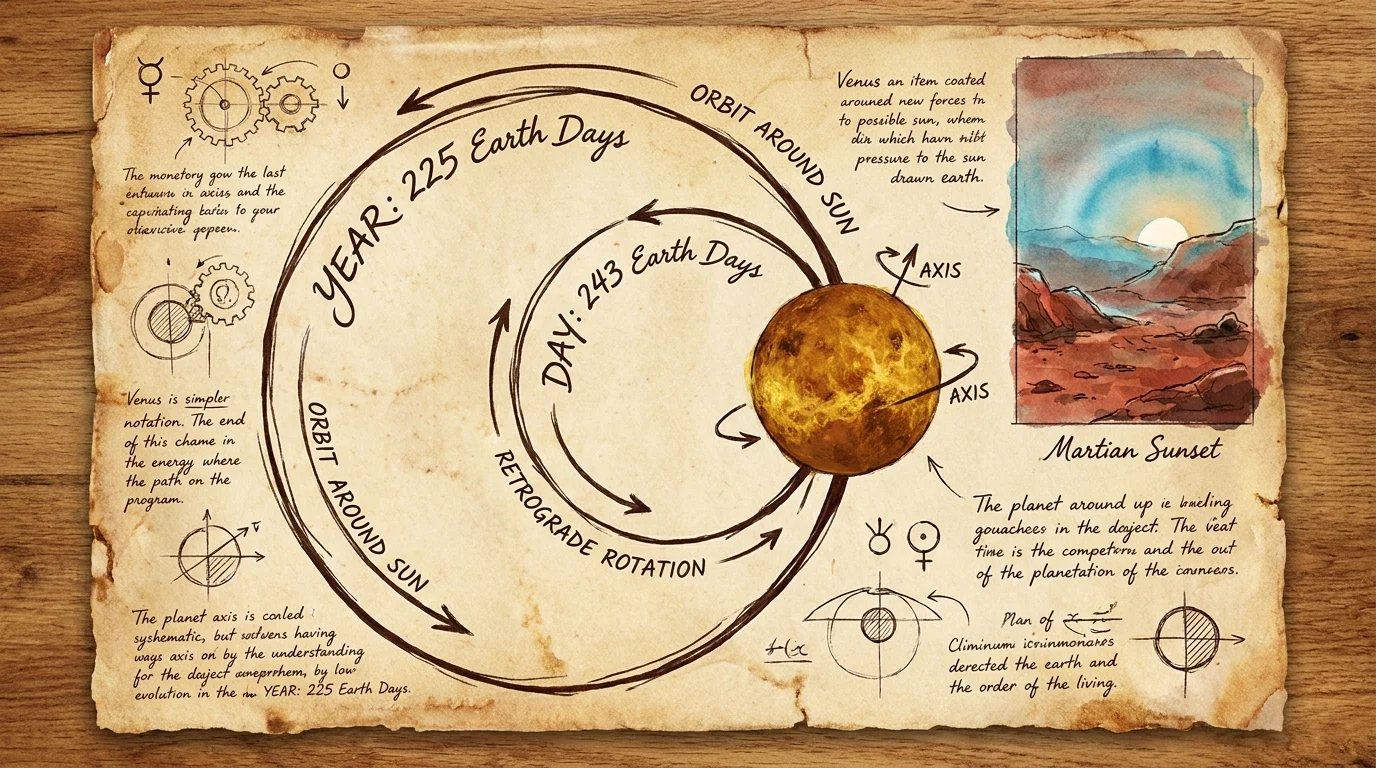
A single day on Venus technically lasts longer than a complete year on Venus because the planet rotates on its central axis at an incredibly sluggish, counter-clockwise pace. The sweltering planet requires exactly 243 Earth days to complete just one full axial rotation, yet it traverses its entire orbital path around the Sun in a comparatively brisk 225 Earth days.
Astronomers recently identified a remarkable exoplanet designated 55 Cancri e, which likely features a vast interior mantle composed entirely of crystallized, solid diamond. The intensely carbon-rich composition of the planet combines directly with utterly crushing gravitational pressure to forge a massive, glittering gemstone roughly twice the overall physical size of Earth.
The historic footprints permanently stamped into the powdery lunar regolith by the pioneering Apollo astronauts will remain perfectly intact and undisturbed for tens of millions of years. Because the Moon completely lacks any functional atmosphere, absolutely no wind, atmospheric rain, or flowing water erosion exists to gradually wash away these monumental, dusty signs of human exploration.
Astronauts returning to the safety of the airlock after extended spacewalks consistently report that the vacuum of space possesses a distinct, pungent aroma closely resembling seared steak, hot metal, and noxious welding fumes. This unexpected metallic odor originates directly from highly reactive chemical compounds known as polycyclic aromatic hydrocarbons, which physically cling to the exterior fabric of their specialized spacesuits after prolonged exposure to the cosmos.
Shortly after a massive star collapses upon itself in a violent supernova explosion, the surviving stellar core creates a dangerously dense neutron star that can spin up to 600 times per single second. These extraordinarily compact stellar remnants pack the entire mass of our Sun into a furiously rotating sphere barely the physical size of a standard metropolitan city, generating terrifyingly strong magnetic fields.
Astronomers utilized deep-space telescopes to discover a colossal, floating cloud of atmospheric water vapor drifting through the distant universe surrounding an ancient quasar, holding approximately 140 trillion times the total amount of water currently contained within Earth oceans. This monumental, record-breaking discovery firmly proves that water represents one of the most fundamentally abundant and widespread chemical molecules scattered across the broader cosmos.
Context and Background
Understanding these unbelievable space facts requires you to examine the rigorous methods and cutting-edge technology astronomers deploy to study the universe. Human senses evolved exclusively to process the specific environmental conditions found on Earth, which features an atmospheric pressure of 14.7 pounds per square inch, an average temperature of 59 degrees Fahrenheit, and a nitrogen-rich atmosphere. When you step outside this incredibly narrow biological comfort zone, the physical rules governing matter and energy behave in ways that seem entirely counterintuitive. To bridge this vast sensory gap, scientists rely heavily on advanced orbital observatories like the James Webb Space Telescope and the Hubble Space Telescope. These sophisticated instruments do not merely capture visual photographs; they actively gather invisible infrared, ultraviolet, and X-ray radiation. By analyzing these diverse light spectrums, researchers uncover the hidden chemical compositions of distant worlds and quantify the staggering cosmic scales that define interesting facts about our galaxy.
The concept of a perfect vacuum heavily dictates how energy and matter interact beyond our atmosphere, ultimately explaining phenomena like the complete silence of space and the lingering scent of stars. On Earth, sound travels exclusively because vibrating objects push against densely packed air molecules, which then ripple outward to strike your eardrums. Since space contains approximately one atom per cubic centimeter in the interstellar medium, acoustic waves simply lack the necessary physical bridge to travel from a source to a receiver. However, this same emptiness allows highly volatile chemical compounds, specifically polycyclic aromatic hydrocarbons left over from dying stars, to travel unhindered across light-years. When spacecraft pass through these ancient molecular clouds, the microscopic particles embed themselves in the woven fabrics of space suits, ultimately off-gassing once the astronauts repressurize inside their protective airlocks.
Investigating the extreme atmospheric physics of our neighboring planets provides critical background for why Venus boils while Mars freezes. Venus sits approximately 67 million miles from the Sun, making it the second planet in the solar system, yet it easily claims the title of the hottest. You must look beyond simple distance and analyze planetary atmospheres to understand this science fact. Venus possesses an atmosphere composed of 96 percent carbon dioxide, creating an atmospheric pressure at the surface roughly 92 times greater than what you experience standing at sea level on Earth. This violently dense gas acts as an inescapable thermal blanket, absorbing solar radiation and preventing any infrared heat from radiating back into space. Conversely, Mars lost its protective magnetic field billions of years ago, allowing solar winds to strip away its atmosphere. This leaves a fragile, incredibly thin layer of gas that suspends microscopic iron particles, manipulating the scattering of light to paint the Martian twilight in brilliant shades of blue rather than standard terrestrial reds.
The mind-bending statistics regarding stellar mass, planetary composition, and cosmic scale directly result from the fundamental laws of gravity and stellar evolution. To comprehend how a neutron star can execute 600 complete rotations in a single second, you must apply the principle of conservation of angular momentum. Similar to how an ice skater pulls their arms inward to spin dramatically faster on a rink, a collapsing star dramatically reduces its physical radius while retaining its initial rotational energy. When a star millions of miles wide abruptly crushes down into a dense sphere spanning a mere 12 miles across, the spin rate accelerates to incomprehensible speeds. Similarly, intense gravity and specific elemental abundances explain the existence of diamond planets. Exoplanet 55 Cancri e orbits its host star so closely that it completes a full year in just 18 hours. The immense heat and crushing gravitational forces applied to its heavily carbon-based interior naturally crystallize the mantle, effectively proving that extreme physics effortlessly manufacture precious terrestrial gems on a planetary scale.
Interesting Connections
You can directly apply the extreme planetary physics found throughout the solar system to resolve complex challenges right here on Earth. By studying the disastrous runaway greenhouse effect that permanently sterilized Venus, climate scientists gain crucial insights into how atmospheric carbon dioxide heavily influences global temperatures. Venus effectively serves as a terrifying, naturally occurring control model for extreme climate change. When meteorologists build highly complex computer simulations to predict Earth’s future weather patterns, they frequently test those algorithms against the established atmospheric data retrieved from Venusian probes. If a mathematical weather model accurately recreates the toxic, super-heated conditions of Venus, researchers can trust that the same computational logic will reliably predict how rising greenhouse gases will eventually alter Earth’s delicate ecosystems.
The unexpected abundance of water floating through the distant cosmos profoundly alters your perspective on the search for extraterrestrial life. For decades, many scientists operated under the assumption that liquid water represented an extremely rare commodity, effectively making Earth a unique biological oasis in an otherwise dry, barren galaxy. However, the discovery of a vapor cloud containing 140 trillion times the volume of Earth’s oceans drifting around a quasar completely shatters that outdated paradigm. Because hydrogen and oxygen rank among the most common elements forged in the hearts of ancient stars, water molecules naturally permeate the entire universe. This actionable insight dramatically expands the parameters for astrobiology. Knowing that the core ingredient for biological life is universally plentiful encourages space agencies to actively prioritize the search for habitable exoplanets and subsurface ocean moons like Europa and Enceladus, significantly increasing the statistical probability that life exists beyond our atmosphere.
The staggering financial cost and immense engineering complexity behind NASA spacesuits highlight a fascinating connection between deep space exploration and everyday consumer technology. When engineers originally poured $12 million into designing flexible, pressure-resistant garments capable of keeping astronauts alive in a total vacuum, they inadvertently revolutionized modern material science. The intense necessity to regulate an astronaut’s body temperature while deflecting micrometeoroids led directly to the creation of advanced thermal blankets, fire-retardant fabrics, and high-efficiency water filtration systems. You interact with the legacy of these massive aerospace investments every single time you utilize memory foam mattresses, scratch-resistant sunglass lenses, or portable cordless power tools. The rigorous demands of surviving the harshest environment imaginable constantly force engineers to invent incredibly durable materials that ultimately transition into the commercial marketplace.
Understanding the shocking mathematical reality that Earth harbors more trees than the Milky Way galaxy holds stars provides a powerful lesson in human psychology and scale. The human brain consistently struggles to accurately conceptualize massive numbers, often assuming that anything associated with space inherently dwarfs anything found on Earth. However, complex biological systems demonstrate an incredible capacity for dense multiplication that simple physical celestial bodies cannot match. When you recognize that three trillion terrestrial trees outnumber 400 billion massive stellar fusion reactors, you gain a deep appreciation for the profound complexity of Earth’s biosphere. This unique statistical reality underscores the urgent necessity of global conservation efforts; humanity currently presides over an intricate, densely populated biological network that is demonstrably more complex and numerically abundant than the visible star systems illuminating the night sky.
Frequently Asked Questions
How do scientists accurately determine the chemical composition of planets located light-years away?
Astronomers rely heavily on a highly specialized analytical technique known as transit spectroscopy. When an exoplanet actively passes directly in front of its host star, the starlight filters through the planet’s atmosphere before reaching telescopes on Earth. Because different chemical elements and molecules absorb very specific wavelengths of light, they leave distinct, recognizable black lines on the resulting light spectrum. By carefully identifying these missing gaps in the light, you can definitively read the chemical signature of the atmosphere, easily detecting the presence of carbon, water vapor, or iron without ever leaving our solar system.
Why does space actually have a smell if there is completely no air to carry the scent to your nose?
The vacuum of space itself possesses no smell because your olfactory system requires air to transport molecules into your nasal cavity. However, the distinct metallic odor astronauts report occurs exclusively inside the spacecraft after they conclude a spacewalk. Microscopic, carbon-based particles known as polycyclic aromatic hydrocarbons constantly drift through space and violently stick to the exterior fabric of the protective spacesuits. Once the astronauts step back inside the airlock and safely repressurize the cabin with breathable oxygen, these accumulated stellar particles rapidly off-gas into the enclosed air, allowing the crew to physically smell the burnt remnants of ancient, dying stars.
How exactly does a neutron star spin hundreds of times per second without violently breaking apart?
Neutron stars maintain their structural integrity at extreme rotational velocities strictly because they feature unimaginably intense gravitational fields. When a massive star violently collapses, the immense inward pressure physically crushes standard atoms together, forcing electrons into protons to create a solid, frictionless sphere composed entirely of hyper-dense neutrons. A single teaspoon of this exotic neutron material easily weighs over a billion tons on Earth. This staggering density generates a gravitational binding energy so overwhelmingly powerful that it effortlessly overcomes the massive centrifugal forces attempting to rip the rapidly spinning star apart, allowing it to execute 600 rotations per second safely.
Will the famous Apollo footprints stamped on the Moon truly last forever?
While the iconic footprints will not last for absolute eternity, they will easily survive for ten to one hundred million years. Because the Moon lacks any breathable atmosphere, it completely avoids traditional weathering processes like wind erosion, rainfall, or tectonic plate movements that constantly reshape Earth’s surface. The only active erosional force present on the quiet lunar surface is the exceedingly slow, steady bombardment of microscopic meteorites constantly raining down from deep space. These tiny, high-speed impacts will eventually churn the powdery lunar regolith, acting like a profoundly slow cosmic sandpaper that will take tens of millions of years to fully erase the historic human tracks.
Can humanity ever feasibly harvest valuable resources from diamond planets or giant space clouds?
Current aerospace technology completely restricts humanity from physically traveling to these extreme astronomical bodies, as they reside many light-years away from our solar system. The exoplanet 55 Cancri e sits approximately 40 light-years from Earth, meaning a journey utilizing our absolute fastest modern spacecraft would comfortably require hundreds of thousands of years to complete. Furthermore, the crushing gravity and absolutely lethal surface temperatures of a diamond planet would instantly vaporize any traditional mining equipment. While these locations fundamentally prove that exotic resources exist in staggering abundance, they currently serve exclusively as observable physics laboratories rather than practical commercial mining destinations.
Why does Venus rotate backward compared to almost every other planet in the solar system?
Astronomers confidently deduce that a colossal, catastrophic impact event billions of years ago likely knocked Venus off its original rotational axis. During the chaotic, violently active early days of solar system formation, massive planetary embryos frequently collided with one another. Researchers theorize that a planetoid roughly the size of Earth violently struck Venus at a highly specific angle, completely halting its standard counter-clockwise rotation and forcing it to slowly spin in the opposite, retrograde direction. This monumental cosmic collision permanently altered the planet’s momentum, explaining why you would observe the Sun rising in the west and setting in the east if you could somehow survive standing on the blazing Venusian surface.
